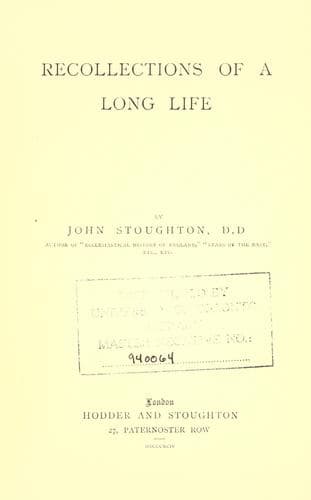
Clergy -- England -- Biography; Stoughton, John, 1807-1897
“Let me remind our English friends,” he said, “of the words their great
poet puts in the mouth of Richard II.:
‘Look not to the ground
Ye favourites of a king! Are we not high?
High be our thoughts.’
“Let us cherish high thoughts, my friends! Are we not the servants of a
King, of the King of kings, and Lord of lords? And is it not His work we
are carrying on?
‘Die sach’ ist dein, Herr Jesu Christ,
Die sach’ an der wir stehen.’
(The cause is Thine, Lord Jesus Christ,
The cause for which we stand.)
“Thus let our work be done, our testimony be given, our efforts be
united, in the same joyful steadfast spirit, with the same buoyancy, with
which the Apostle, with chained hands, appealed to his flock at Philippi,
‘Rejoice in the Lord always, and again I say, rejoice.’”
These were animating words, and awakened an enthusiastic response, when
uttered in the old church of St. Martin, where Æcolampadius first
preached the doctrines of the Reformation.
I give the following _resumé_ of some remarks I made at the Basle
Alliance meeting.
_The Times_ reported:
“Dr. Stoughton contrasted the gathering of peoples in that assembly,
representative of all nations, with a meeting held in Basle four hundred
and fifty years ago. Christendom was then in a very divided state, for
the spirit of religious inquiry was breaking out, and the great
moot-point was, in all theological controversy, ‘Where lies the ultimate
authority for religious beliefs—in Popes, in Councils, or in the Word of
God?’ They met that day in times of a somewhat differentcharacter, but
of still deeper and wider agitation, for the question now was, not only
whether the Church or the Bible was the final test of truth, but also
whether reason or revelation should be our guide as to the highest of all
subjects which could affect the present and future interests of the human
family. But how vast the difference between that famous Council at Basle
and the Evangelical Alliance Conference of this day! Under what
different aspects was union regarded by the two assemblies! The one
aimed at uniformity, at a precise and definitely-expressed agreement of
opinion, in relation to theological and ecclesiastical points, which
might be enforced on all Christendom by pains and penalties,—even death,
to a recreant brother. The other seeks to promote unity, holding, after
the experience of ages, that uniformity was impossible, and that true
unity could not only be attained, but was compatible with a hearty,
loving, sympathetic Christian fellowship throughout the family of the
redeemed. He then contrasted the appearance of the two meetings, traced
out the history of the followers of John Huss, and, in a long and
exceedingly able and interesting historical review of the history of the
Reformation, showed that Protestant England was not only indebted to
Basle for men but for principles; and, identifying the two with the work
Public-domain text, read in full here on John Shaqi.
Reviews
Reviews
No reviews yet
Be the first to share your thoughts on this work.
Elsewhere in the archive
Join the Discussion
Join the discussion
Sign in to leave a comment or review.
Sign InorCreate an account