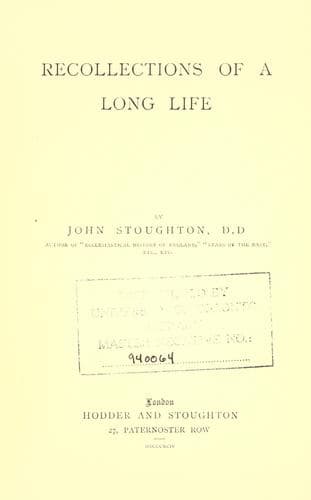
Clergy -- England -- Biography; Stoughton, John, 1807-1897
He had much of the mind which distinguished “that disciple whom Jesus
loved.” His singular sweetness of disposition was partly natural, for he
was a gentle, quiet boy, winning many hearts; but it was gracious and
spiritual also, a result of sincere discipleship to the Divine Master. I
often felt surprised at his extraordinary amount of forbearance under
most unjust and cruel attacks. I once alluded to the need of patience
amidst such trials, instancing Archbishop Tillotson, who left behind him
a bundle of scurrilous letters, labelled with the words, “May God forgive
the writers as I do.” I learned from my friend that once he was accused
of infidelity by an anonymous correspondent; and on another occasion,
after the figures of Moses, David, Paul, and Peter had been placed in the
choir of the Abbey, he received a note beginning with a charge of
idolatry. Our Broad Church Dean, and the prelate of the Revolution were
ecclesiastically and socially much alike. As to theology the former told
me there is much in the teaching of Scripture which transcends human
conception, much which, running along lines of mystery, he felt himself
unable to follow; but, at the same time, he would remark, there is much
more that is plain, which “a wayfaring man, though a fool,” may receive
and “not err therein.” To these plain things, he said, he desired to
cleave; these plain things he endeavoured to preach. The main difference
between others and himself was that certain Evangelical principles were
plainer to them than to him.
His interest in Bible study was intense, especially with regard to
historical and biographical subjects; and it was well said, that whilst
some critics seemed to delight in destroying certain parts, his delight
was to build them up into a grand whole. His habit was to maintain
truth, so far as he saw it, rather than to attack and overthrow error;
and his gift of felicitously adapting events and passages of Holy Writ to
passing incidents and characters, was truly wonderful; especially when an
opportunity occurred for weaving sacred associations round the walls of
his beloved Abbey. Nor did he fail to turn his skill in this respect to
admirable account, when preaching in America.
Dr. Stanley’s amiableness never betrayed a suspicion of weakness in his
character. Indeed he had a side almost stern in some of its appearances;
and he fought against what he deemed evil, with great vehemence; and
stood up very boldly, I know, against unprincipled people, declaring that
he would not meet them, except in the presence of witnesses.
To see him at his best was to be with him alone, when he gave full sway
to his thoughts and feelings, expressing them with greater freedom than I
ever heard him do in company. The most enjoyable time was late in the
evening, after guests had retired; especially when he conducted me to my
bedroom, candlestick in hand, and tarried for a good while chatting about
subjects and persons of interest to us both.
Public-domain text, read in full here on John Shaqi.
Reviews
Reviews
No reviews yet
Be the first to share your thoughts on this work.
Elsewhere in the archive
Join the Discussion
Join the discussion
Sign in to leave a comment or review.
Sign InorCreate an account