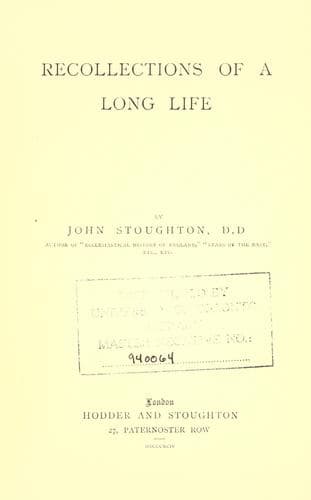
Clergy -- England -- Biography; Stoughton, John, 1807-1897
When I was a member of the Wesleyan Society, I attended class according
to rule, and I found the practice beneficial, inasmuch as it was a
constant spur to self-examination. The primitive agape, revived amongst
the Methodists, exists under the name of love-feast, at which, together
with eating bread and drinking water as an expression of fellowship, men
and women are accustomed voluntarily to rise, and give some account of
their religious experience for edification to others. These addresses I
found often interesting and useful. By such means, a habit of spiritual
intercommunication amongst Methodists is kept alive; beneficial in some
cases no doubt, but liable to abuse in others, as most good things are.
I am constrained to relate how this habit on the bright side manifested
itself on a private occasion during a meeting of Conference in London.
Dr. Jobson, an eminent Wesleyan, invited a party of friends to his house.
He kindly included me in the number, and I found at his hospitable board
the President for the year, and some ex-presidents. Together with them,
Drs. Binney, Raleigh, Allon, and Donald Fraser were present. Our host
was a thorough Methodist, and very comprehensive in his sympathies, for
he had mixed with different denominations. He had many friends in the
Establishment, and in early life had studied under an eminent Roman
Catholic architect, at whose house he met bishops and priests of that
communion. On the occasion I refer to, he in an easy way initiated a
conversation which I can never forget. He appealed to his guests, one by
one, for some account of their religious life. All readily responded;
and this is most remarkable,—all who spoke attributed to Methodism
spiritual influence of a decisive kind. To use Wesleyan phraseology,
most of them had been “brought to God” through Methodist instrumentality.
Dr. Osborne was present, and made some remarks, at the close of which,
with choked utterance, he repeated the verse—
“And if our fellowship below,
In Jesus be so sweet,
What heights of rapture shall we know,
When round the throne we meet?”
Public-domain text, read in full here on John Shaqi.
Reviews
Reviews
No reviews yet
Be the first to share your thoughts on this work.
Elsewhere in the archive
Join the Discussion
Join the discussion
Sign in to leave a comment or review.
Sign InorCreate an account