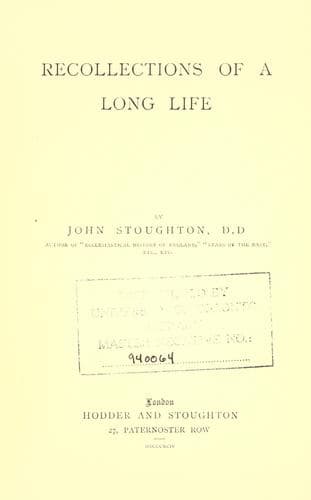
Clergy -- England -- Biography; Stoughton, John, 1807-1897
VI. Respecting the Congregationalist denomination, of which I have
spoken already, let me add that in 1877 I was requested by Dr. Schaff, of
New York, to give my impression of prevalent beliefs amongst us. I
replied as follows: “Looking at the principles of Congregationalism,
which involve the repudiation of all human authority in matters of
religion, it is impossible to believe that persons holding those
principles can consistently regard any ecclesiastical creed or symbol in
the same way as Catholics, whether Roman or Anglican, regard the creeds
of the ancient Church. There is a strong feeling against the use of such
documents for the purpose of defining limits of religious communion, or
for the purpose of checking the exercise of free inquiry; and there is
also a widespread conviction that it is impossible to reduce the
expression of Christian belief to a series of logical propositions, so as
to preserve and represent the full spirit of Gospel truth.” (See
Schaff’s “Creeds of Christendom,” p. 833.)
No doubt there may be heard in some circles loose conversation, seeming
to indicate such a repugnance to creeds as would imply a dislike to all
formal definitions of Christian doctrine; but I apprehend the prevailing
sentiment relative to this subject among our ministers and churches does
not go beyond the point just indicated. Many of them consider that while
creeds are objectionable as tests, and imperfect as confessions, they may
have a certain value as manifestoes of conviction, on the part of
different communities.
Some people write and talk on the subject of present opinion, with a
positiveness which only omniscience could warrant. No mortal can know
what is going on in the minds of thousands, touching momentous subjects;
yet such knowledge is requisite for the confident conclusions of certain
critics. We may speak decidedly of what is commonly taught in a
community, yet this should be done with qualifications and no farther.
Silence on momentous points may prove a loss as to the full wealth of
theology; but I am thankful for gain at the present day in richer views
than formerly of our Lord’s character, and the bearing of it upon life
and conduct. Let me add, however, if _Redemption_ in all its fulness be
not prominent in pulpit ministrations, power will be gone. Some suppose
we are making theological advance, and that discoveries are opening akin
to those in physical science; but people who have more carefully surveyed
the wide field, and more observantly studied the history of religious
thought, discover that much as seen at first sight, is chiefly a falling
back upon what was old and forgotten.
In closing what I have to say of modern Congregationalists, I venture to
notice deceased ministers whom it has been a privilege to number amongst
my friends.
Public-domain text, read in full here on John Shaqi.
Reviews
Reviews
No reviews yet
Be the first to share your thoughts on this work.
Elsewhere in the archive
Join the Discussion
Join the discussion
Sign in to leave a comment or review.
Sign InorCreate an account