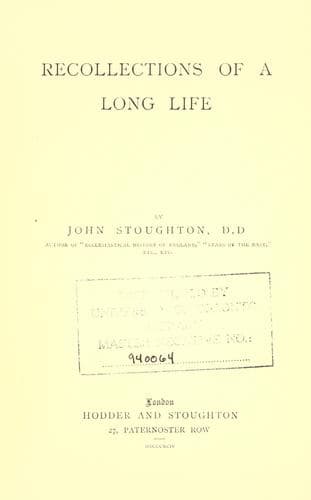
Clergy -- England -- Biography; Stoughton, John, 1807-1897
About 1830 the wiser heads amongst us had clearly seen the evil, and
endeavoured to overcome it. They concluded that centrifugal tendencies
should be met by a centripetal force. Mr. Binney used to say, we were a
collection of limbs—legs, arms, feet, and hands—all in motion, but not an
organised body. To frame a body out of so many members, was the design
of the Congregational Union. Algernon Wells may be regarded as its
founder. He was one of the most beautiful characters I have ever
known—intelligent, well read, sagacious, with extensive knowledge of men
and things, and a profound attachment to evangelical truth. He had a
rare order of eloquence, and wove pleasant tissues of thought in his
sermons and speeches. If his speeches were not always sermons, his
sermons were almost always speeches. There was a great charm in his
conversation, and it often overflowed with wit. Though a decided
Congregationalist, he was full of charity, and cultivated harmonious
intercourse with other denominations. His policy as to the newly-formed
organisation, was to make the meetings fraternal rather than
controversial—a brotherly society to promote edification rather than an
ecclesiastical army to fight with soldiers outside, or a council to
settle disputes inside. The early meetings were held in the
Congregational Library, and did not muster more than a hundred members.
“Business” received at times a look askance: spiritual edification
excited desire, and stimulated expression. Now and then came touches of
humour, as when after talking about the state of the denomination till we
were hungry, one brother rose and gravely asked “whether any intelligence
had arrived from the Sandwich Islands.”
Good Algernon Wells died in 1851, and soon afterwards I was requested by
a sub-committee to meet them in conference on an important matter. It
was to propose my election as Mr. Wells’ successor. Now, secretaryships
have always been my aversion—from an instinct, I suppose, such as guides
inferior animals to shun what they were never made for. The
secretaryship of the City Mission had been pressed upon me soon after my
arrival in London, but I steadily refused it, from a conviction of utter
incompetence; and, for the same reason, I declined to entertain the
proposal just mentioned. He who proposed the office for me accepted it
for himself, and we worked together pleasantly through several years. I
was elected chairman of the Union in May 1856, amidst much excitement.
There have been strains on its strength more than once, but this first
was the greatest.
Public-domain text, read in full here on John Shaqi.
Reviews
Reviews
No reviews yet
Be the first to share your thoughts on this work.
Elsewhere in the archive
Join the Discussion
Join the discussion
Sign in to leave a comment or review.
Sign InorCreate an account