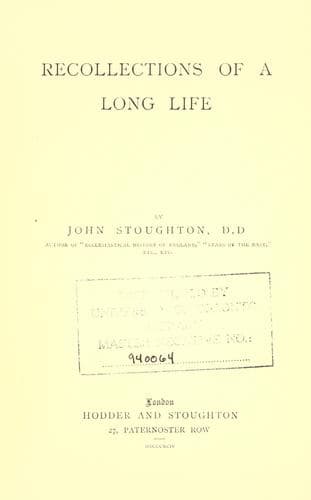
Clergy -- England -- Biography; Stoughton, John, 1807-1897
In 1872 an incident occurred of an amusing description, which, as it has
some significancy, is worthy of notice. A paragraph appeared in a
religious newspaper to the following effect: “The Revs. Dr. Binney, Dr.
Allon, and Dr. Stoughton have been, it seems, presented to His Grace the
Archbishop of Canterbury at Lambeth Palace, by that consistent advocate
of comprehension, Dr. Stanley, Dean of Westminster. It remains to be
seen whether the Archbishop will invite either of the Doctors to preach
in any of the Metropolitan churches, if not in the Abbey, or in the
Cathedral. The Act of Uniformity will have to be repealed.” If anybody
who read this announcement had been acquainted with the circumstances, he
would have seen its absurdity. The visit arose from an informal
invitation to a party at Lambeth—from Dr. Tait, who was well acquainted
with all the three persons. They needed no “presentation,” such as the
newspaper imagined. It is a curious fact, that, while some people
complain of Dissenters being ignored or repulsed by the upper classes,
when, instead of it, there is friendly recognition, the complainants
imagine that, if the two classes do meet, there must be obsequiousness on
the one side, and patronage on the other. It is supposed an impossible
thing, for a Dignitary and a Dissenter to meet as gentlemen, without any
professional design; on the occasion referred to, ecclesiastical objects
no more entered the head of the host, as he welcomed us with cordiality,
than it entered the heads of his guests. It was an affair of social
courtesy, in which politeness on the one side, I hope, was returned on
the other. By the way, at a Lambeth reception, after mingling with
friends whom I had known for some years, I heard Mr. Binney say to Bishop
Wilberforce: “Are you not surprised to see us here?”
“Surprised! Why, if you were not here, who should be here?”
This rejoinder puzzled my friend, when I ventured to add, “I understand
your compliment, my lord, but at least you will acknowledge, it is
something new.”
“No, not new,” he rejoined, and laying his hand on my shoulder, proceeded
to say, “What is right is not new: is not righteousness as old as the
creation?”
“Then you consider it is right for us to be here,” I ventured to remark.
“Certainly; delighted to see you.”
Public-domain text, read in full here on John Shaqi.
Reviews
Reviews
No reviews yet
Be the first to share your thoughts on this work.
Elsewhere in the archive
Join the Discussion
Join the discussion
Sign in to leave a comment or review.
Sign InorCreate an account