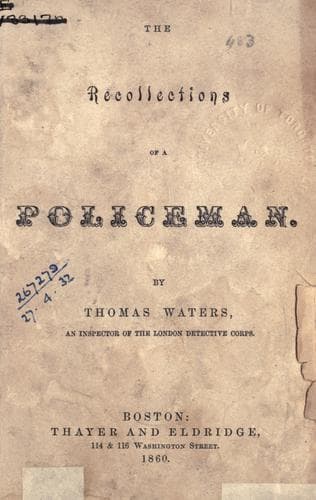
Detective and mystery stories, English; Police -- Fiction; Short stories
"I promise to pay to --------, or Bearer, ---- London ----."
There was to be a Britannia in the corner. When it was done, Mr. Sneed
(for that was the _alias_ Vaughan adopted) came again, but objected to
the execution of the work. The Britannia was not good, and the words "I
promise" were too near the edge of the plate. Another was in consequence
engraved, and on the fourth of March, Vaughan took it away. He
immediately repaired to a printer, and had forty-eight impressions taken
on thin paper, provided by himself. Meanwhile, he had ordered, on the
same morning, of Mr. Charles Fourdrinier, another engraver, a second
plate, with what he called "a direction," in the words, "For the
Governor and Company of the Bank of England." This was done, and about a
week later he brought some paper, each sheet "folded up," said the
witness, "very curiously, so that I could not see what was in them. I
was going to take the papers from him, but he said he must go upstairs
with me, and see them worked off himself. I took him up-stairs; he would
not let me have them out of his hands. I took a sponge and wetted them,
and put them one by one on the plate in order for printing them. After
my boy had done two or three of them, I went down-stairs, and my boy
worked the rest off, and the prisoner came down and paid me."
Here the Court pertinently asked, "What imagination had you when a man
thus came to you to print on secret paper, 'the Governor and Company of
the Bank of England?'"
The engraver's reply was:--"I then did not suspect anything; but I shall
take care for the future." As this was the first Bank-of-England-note
forgery that was ever perpetrated, the engraver was held excused.
It may be mentioned, as an evidence of the delicacy of the reporters,
that in their account of the trial, Miss Bliss's name is not mentioned.
Her designation is "a young lady." We subjoin the notes of her
evidence:--
"A young lady (sworn). The prisoner delivered me some bills; these are
the same (producing twelve counterfeit Bank notes sealed up in a cover,
for twenty pounds each;) said they were Bank bills. I said they were
thicker paper--he said all bills are not alike. I was to keep them till
after we were married. He put them into my hands to show he put
confidence in me, and desired me not to show them to anybody; sealed
them up with his own seal, and obliged me by an oath not to discover
them to anybody, and I did not till he discovered them himself; he was
to settle so much in Stock on me."
Vaughan urged in his defence that his sole object was to deceive his
affianced, and that he intended to destroy all the notes after his
marriage. But it had been proved that the prisoner had asked one John
Ballingar to change first one, and then twenty of the notes; but which
that person was unable to do. Besides, had his sole object been to
dazzle Miss Bliss with his fictitious wealth, he would most probably
have intrusted more, if not all the notes, to her keeping.
Public-domain text, read in full here on John Shaqi.
Reviews
Reviews
No reviews yet
Be the first to share your thoughts on this work.
Elsewhere in the archive
Join the Discussion
Join the discussion
Sign in to leave a comment or review.
Sign InorCreate an account