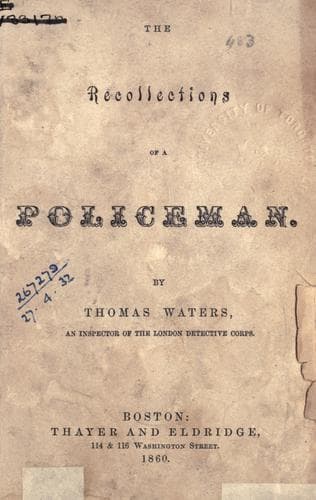
Detective and mystery stories, English; Police -- Fiction; Short stories
Mr. William Wallace arrives at Cathedral number one; and, after being
extremely affected, despite a heavy shower of rain, by the contemplation
of the building, inquires for the Registrar. He is shown a very handsome
house in the Cathedral-close--a house very superior to the
Bishop's--wherein the Registrar resides. For, the Registrar keeps a
first rate roof over his own head, though he keeps his deeds in a
dilapidated Gate-house; at which he takes toll to the amount of seven
thousand a-year; and where, as at other toll-houses, "no trust" is the
rule; for he exacts his fees beforehand.
Mr. William Wallace now learns that, locally, the Registrar is a person
of almost inordinate power; besides his seven thousand-pound-per-annum
place, he is Chapter Clerk, Town Clerk, Clerk to the Magistrates--a
Proctor, moreover, in boundless practice. He lives in great state; he
keeps horses, carriages, dogs, and a yacht; he is--could he be anything
else?--a staunch tory; he generally proposes the tory members for the
county, and has been known to pay the entire electioneering expenses of
a favorite tory candidate. Mr. Wallace, although fortified with a letter
bearing the mitred seal of the Bishop of the diocese, feels that he is
about to come in contact with a great power; an awful something that is
not to be trifled with; one of the noblest institutions of our land, who
is a very Miller of Dee, and accountable to nobody.
With a due sense of the importance of this outside buttress of the
Church, Mr. Wallace presents himself with the Bishop's letter. The
Registrar storms, and takes it extremely ill. He appears to confound Mr.
Wallace with his own foot-boy. He says the Bishop has no power to
interfere with _him_, and he won't endure it. He says the Bishop don't
know what harm may come of showing wills. He can't make out, what people
want to see wills for. He grudgingly concedes some obstructed search, on
the usual terms; namely, two guineas per day for all the days a
clerk--not fond of any sort of fatigue--may choose to take in making any
particular search. "But perhaps you will allow me to look at the
indexes?" asks Mr. Wallace. "_That's_ of no use," is the reply, "for a
great many of the years are missing; and in those we have got, a great
many wills are not entered. We often have to spend two months in finding
a will." Our friend then performs a little mental arithmetic:--two
months--or, even say fifty days--means one hundred guineas, to ferret
out one will. Complete indexes would only occasion ten minutes' search,
equal to one day, or, according to the Registrar's tariff, two guineas.
Mr. Wallace then draws the inevitable conclusion, that bad indexes
partly occasion the inordinate income of the Registrar, whose manifest
interest it is to keep them as imperfect as possible. One little trait
of the very early volumes (the earliest wills are dated A. D. 1180,) is
as quaint, as it is productive to the Registrar: the names of the
Public-domain text, read in full here on John Shaqi.
Reviews
Reviews
No reviews yet
Be the first to share your thoughts on this work.
Elsewhere in the archive
Join the Discussion
Join the discussion
Sign in to leave a comment or review.
Sign InorCreate an account