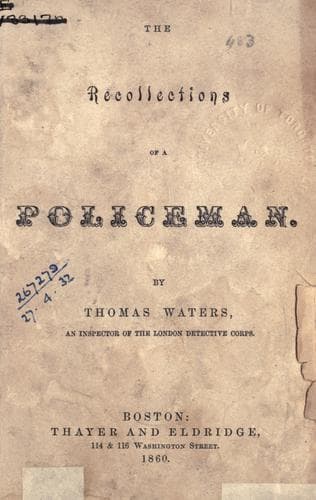
Detective and mystery stories, English; Police -- Fiction; Short stories
In the course of his investigations, it was necessary for him to refer
to a "marriage allegation,"--that is, a copy of the statement made by a
bridegroom previous to converting himself, by the help of the Bishop's
license, into a husband. He then learnt that most of such documents are
the "private property" of one of the clerks, who kept them in his own
private house; that he had bought them of a deceased member of the
Herald's College, and that for each search into them he charged
according to a sliding scale, arranged according to the station of the
applicant, the maximum of which was five pounds for the simple search,
and five pounds more if what the party wanted were found. The English of
this is, that the present custodier of these papers purchased of a dead
Herald what did not belong to him; and what there could have been no
difficulty whatever in restoring to the true owner; (because no one
could have known better than the purchaser that they were public
property); and that their proper place was not his private house, but
the provincial Registry. The produce of this abstraction is an illegal
income better possibly than the legal gains of an Admiral or a
Government Commissioner; double that of a physician in good practice, or
of a philanthropist in easy circumstances,--and treble that of our best
dramatist, or our best poet.
Besides these hindrances, which could not be helped, a certain number of
wilful obstructions were thrown in the way of our inquiring friends,
because they had been desired by the Archbishop to be placed on the fee
free-list. They were watched by the entire office; for it became Argus
for the occasion. Remarks of a satirical character were discharged
point-blank from behind the desks, whenever a good opening occurred. The
non-paying searchers were "in the way"--(this was true, so unfit is the
apartment for public accommodation); "what people got they ought to pay
for, as other people did." Spies slid silently out from behind the
ramparts, or desks, to look over their shoulders, and to see that they
did not purloin any information posterior to the fifteenth century.
Mr. William Wallace stood all this manfully; but his ally was obliged to
retire at the expiration of the second day. Mr. William Wallace at
length found he could not advance the objects of his inquiries any more
efficiently at this Cathedral number two, than he had advanced them at
Cathedral number one; so, at the end of a week, he beat a dignified
retreat with all the honors of war. He then turned his face towards the
unimpeachable Registry of Cathedral number three, hoping for better
success.
CATHEDRAL NUMBER THREE.
Public-domain text, read in full here on John Shaqi.
Reviews
Reviews
No reviews yet
Be the first to share your thoughts on this work.
Elsewhere in the archive
Join the Discussion
Join the discussion
Sign in to leave a comment or review.
Sign InorCreate an account