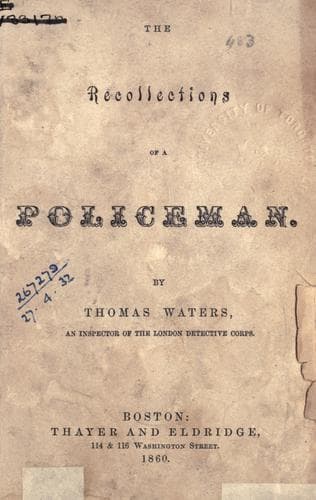
Detective and mystery stories, English; Police -- Fiction; Short stories
Mr. William Wallace had met in Cathedrals numbers one and two, repulses
and rudeness. But each Cerberus who pretended to guard the documentary
treasures of those dioceses, honestly showed his teeth. _They_ had not
been guilty of deceit. Deputy-Registrar number three was wiser in his
generation. He gave a cold assent to the Bishop's mandate in Mr.
Wallace's behalf; but with it such wily instructions to his clerks, as
rendered it as nugatory as if he had put it in his waste basket or had
lighted his cigar. During the two days that half-crowns rained in silver
showers from the Antiquary's purse, nearly every Will he asked for was
produced; but now, on the third day, when the Bishop's letter had closed
his purse-strings, Mr. Wallace demanded document after document, and was
told by the "Conservators" of this important kind of public property,
that they had "been lost," "could not be found," "mislaid." But the most
frequent return was, "destroyed at the siege of the City, in the year
1643"--stolen away with the Tomb of Marmion when
"Fanatic Brooke
The fair Cathedral storm'd and took."
The result of the three days' investigations stood thus: "During the two
paying days, out of a hundred Wills asked for, eighty were produced.
Throughout the non-paying day, out of ninety Wills asked for, only _one_
was produced!"
When half-crowns were rife, not one word was said about "the siege of
the City, in the year 1643," although nearly all the Wills Mr. Wallace
was obliged with a sight of, were dated anterior to that destructive
event.
For some explanation Mr. Wallace repaired to the Deputy-Registrar's
abode. It was too late. The clever sub. knew what was coming--and
retreated from the field. The servant's answer to Mr. Wallace was,
"Out of town, sir!"
But Mr. William Wallace was foiled even more completely in another
point: he had a great desire to see where and how the Wills were kept.
He knew their condition in 1832, from what Ulster King-at-Arms said
before the Ecclesiastical Commission, "I consider the records very
dirty; they have not, apparently, been dusted for many years." The
remarkable result of Mr. Wallace's urgent inquiries was that not a soul
he asked could, or would, tell in what place the ecclesiastical records
of Cathedral number three were deposited.
Mr. Wallace gave up this investigation in despair and left the city.
The _locus_ of the documents was to him a mystery and a wonder!
The habits of the antiquary do not, however, dispose him to indulge in
listless despair. To find out the secret masses of the records of
Cathedral number three was a task Mr. William Wallace had so earnestly
set himself, that next to his domestic relations and his literary
labors, it grew into one of the duties of his existence; therefore, on
his way to Cathedral number four, he paid another visit to the city of
Cathedral number three, fortified with letters to some of its clergy. To
be sure _they_ could clear up the mystery.
Public-domain text, read in full here on John Shaqi.
Reviews
Reviews
No reviews yet
Be the first to share your thoughts on this work.
Elsewhere in the archive
Join the Discussion
Join the discussion
Sign in to leave a comment or review.
Sign InorCreate an account