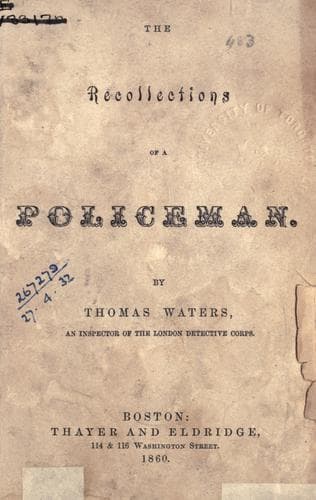
Detective and mystery stories, English; Police -- Fiction; Short stories
Mr. William Wallace, pleasingly surprised at the contrast this Registry
number four presented to others he had visited, and where he had been so
egregiously snubbed, determined to learn and see as much respecting it
as possible. With this view, he applied, without any other introduction
than his card, to the Registrar; whose excellent custom it was, he
understood, to be in attendance daily for several hours. At that time
he was examining witnesses in a case for the Ecclesiastical Court, and
handed the card to the bishop's secretary, who was also in official
attendance. "That gentleman," says Mr. Wallace, "immediately came down,
and informed me that the Bishop had written to me, in answer to my
application, two days before, giving me permission to search, at
reasonable hours, and that the Registrar, as was his usual custom, had
not the slightest objection. I then asked to be shown the various parts
of the building, the modes of preserving the records, which request was
granted without the smallest hesitation."
Our informant then goes on to say that he found the building--which was
raised solely at the expense of the present Registrar, since his
appointment in 1837--conveniently divided into different departments
like the best of the Government offices,--each department legibly
indicated for the benefit of the inquirer, on the different doors.
The manner in which the records are preserved at this Cathedral number
four, is spoken of by our friend with satisfaction. His report to us is
silent on rats, wet, mildew, smoke, broken windows, torn testaments, and
illegible calendars. "Modern wills," he repeats, "are copied at length
into volumes, by the present Registrar, a practice which I regret is not
adopted at York, Lincoln, Lichfield, Winchester, and other places I have
visited. If wills of an earlier date than that of the enrolment books
are required to be taken out of the office for production in any Court
of Law, &c., an examined copy made for the purpose, is deposited in its
place during its temporary removal from the Registry. The principal
portion of the wills are deposited in a dry, but not a fire-proof
building, in good repair, called the Abbey Gateway; where, during the
office hours, two clerks are constantly kept at work in copying wills
that come in. These are kept in boxes, arranged upon shelves with just
sufficient space to admit them, like drawers; and upon the top of the
wills is a sheet of pasteboard fitting the box, as a further protection
from dust. The wills are alphabetically arranged in the boxes, which are
of uniform size, and contain more or less letters; the first box for
1835, for instance, contains the wills of testators whose names commence
with A. or B. The wills of each letter are placed separately, and are
divided into packets of one month each, so that the exact date of
Probate being known, the will is found immediately."
Public-domain text, read in full here on John Shaqi.
Reviews
Reviews
No reviews yet
Be the first to share your thoughts on this work.
Elsewhere in the archive
Join the Discussion
Join the discussion
Sign in to leave a comment or review.
Sign InorCreate an account