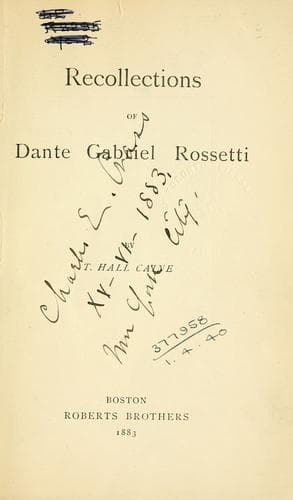
Recollections of Dante Gabriel RossettiCaine, Hall, Sir
Philosophy
Recollections of Dante Gabriel Rossetti
Caine, Hall, Sir
Rossetti, Dante Gabriel, 1828-1882
and nearly all the phrases satirised are borrowed from Coleridge’s
own poetry, not from that of Lamb or Lloyd. Nevertheless, Cottle was
doubtless right as to the fact that Lamb took offence at Coleridge’s
conduct on this account, and Rossetti almost certainly made a good shot
at the truth when he attributed to the rupture thereupon ensuing the
passage on severed friendship. The sonnet on _The House that Jack Built_
is the finest of the three as a satire.
* So in the Biographia Literaria; in Cottle, “Eve darkens
into night.”
Indeed, the figure used therein as an equipoise to “the hindward charms”
satirises perfectly the style of writing characterised by inflated
thought and imagery. It may be doubted if there exists anything more
comical; but each of the companion sonnets is good in its way. The
egotism, which was a constant reproach urged by _The Edinburgh_ critics
and by the “Cockney Poets” against the poets of the Lake School, is
splendidly hit off in the first sonnet; the low and creeping meanness,
or say, simpleness, as contrasted with simplicity, of thought and
expression, which was stealing into Wordsworth’s work at that period,
is equally cleverly ridiculed in the second sonnet. In reproducing the
sonnets, Coleridge claims only to have satirised types. As to Lamb’s
letter, it is, indeed, hard to realise the fact that the “gentle-hearted
Charles,” as Coleridge himself named him, could write a galling letter
to the “inspired charity-boy,” for whom at an early period, and again at
the end, he had so profound a reverence. Every word is an outrage, and
every syllable must have hit Coleridge terribly. I called Rossetti’s
attention to the surprising circumstance that in a letter written
immediately after the date of the one in question, Loyd tells Cottle
that he has never known Lamb (who is at the moment staying with him) so
happy before as _just then!_ There can hardly be a doubt, however,
that Rossetti’s conjecture is a just one as to the origin of the great
passage in the second part of _Christabel_. Touching that passage I
called his attention to an imperfection that I must have perceived, or
thought I perceived long before,--an imperfection of craftsmanship that
had taken away something of my absolute enjoyment of its many beauties.
The passage ends--
They parted, ne’er to meet again!
But never either found another
To free the hollow heart from paining--
They stood aloof, the scars remaining,
Like cliffs which had been rent asunder;
A dreary sea now flows between,
But neither heat, nor frost, nor thunder,
Shall wholly do away, I ween,
The marks of that which once hath been.
Public-domain text, read in full here on John Shaqi.
Reviews
Reviews
No reviews yet
Be the first to share your thoughts on this work.
Elsewhere in the archive
Join the Discussion
Join the discussion
Sign in to leave a comment or review.
Sign InorCreate an account