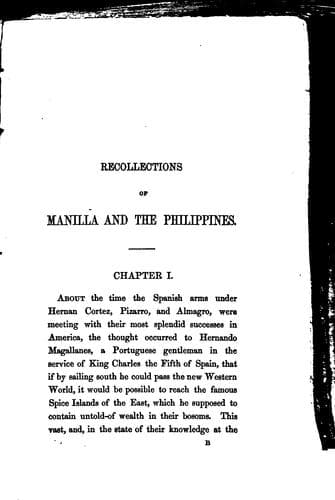
Recollections of Manilla and the Philippines: During 1848, 1849 and 1850MacMicking, Robert
History
Recollections of Manilla and the Philippines: During 1848, 1849 and 1850
MacMicking, Robert
Manila (Philippines); Philippines
The present cultivators, who show a high degree of intelligence
in many of their operations, in cultivating their staple, rice,
for example, actually expend more labour on their land, and work
much more constantly than any hirelings would do; as at Jalajala,
out of upwards of a hundred labourers in the village who had no other
employment or source of revenue but their labour, not above a third
of the able-bodied men mustered in the fields when the labours of
the day began in the morning; and I understood from the owner of the
estate, that under no circumstances could he prevail on the whole
body of labourers to muster, nor, so long as their rice lasts, will
they work; it is only when that fails, and they will starve if they
do not exert themselves, that they will undergo hard labour in the
fields under the broiling sun.
CHAPTER XIX.
Very few of the native Indians or Mestizos are possessed of much
wealth, according to British ideas of the term, although there are some
of the latter class who are considered among themselves as very well
off, if their savings amount to from five to twenty thousand dollars;
and when they reach fifty thousand dollars, they are looked upon as
rich capitalists.
In Manilla, there are one or two of these Mestizo traders whose
fortunes amount to more than this; but such occurances are rare,
and are seldom heard of. Many of these amounts have been collected
together by their possessors by their engaging in a sort of usurious
money-lending or banking business with the poverty-struck cultivators
of the soil, by advancing seed to many of them for their paddy fields,
and making the hard condition of exacting in return about one half
of the produce of the ensuing crop. But perhaps these money-lenders
are, to a certain extent, necessary to supply the wants of an
improvident and careless race, these habits being besetting sins of
the Indian character; yet there can be little doubt that the money
acquired by such a usurious repayment of the sums advanced, does
an immense deal of harm, and lessens the natural independence of
the Indians who are so unfortunate as to fall into the clutches of
the money-lender. Should a poor Indian, the possessor of a patch of
paddy-land capable of producing very little more than is required to
feed his family, once run short of seed, he has a very hard battle to
fight with the soil before he is able to get that debt cleared off,
should his neighbours be too poor to assist him, as he must then have
recourse to the usurer. For although, through his greater efforts and
improved cultivation, he may produce much more paddy than his land
had done before, yet he is seldom able to save enough for seed from
the moiety of the produce which his appetite restricted to live upon,
as the other half must go to repay the usurer who advanced him seed,
or money to purchase it.
Public-domain text, read in full here on John Shaqi.
Reviews
Reviews
No reviews yet
Be the first to share your thoughts on this work.
Elsewhere in the archive
Join the Discussion
Join the discussion
Sign in to leave a comment or review.
Sign InorCreate an account