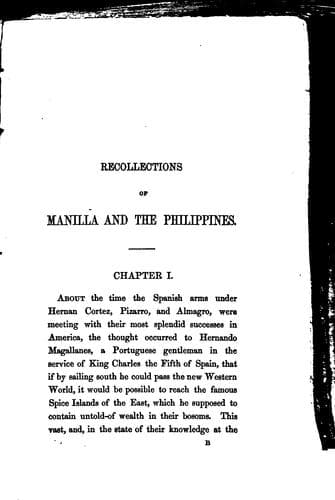
Recollections of Manilla and the Philippines: During 1848, 1849 and 1850MacMicking, Robert
History
Recollections of Manilla and the Philippines: During 1848, 1849 and 1850
MacMicking, Robert
Manila (Philippines); Philippines
Great numbers of people are also employed as fishermen, artizans
of all sorts, and as manufacturers of cloth fabrics of various
descriptions. In addition to the people so gaining a livelihood
by their industry, there are scattered throughout the islands many
Indians, without any occupation, and apparently altogether dependent
on the fruit of the plaintain-tree for subsistence, and indulging
all their natural laziness and indolence of disposition by its aid,
preferring to subsist on the fruit of this most productive plant,
which they can do, from its being always procurable and at all times
of the year in season, without an effort towards its cultivation,
to undertaking the labour and attention necessary to grow rice.
Some of these people are hunters, occasionally going out to the
wilds in pursuit of game, which must alternate beneficially with
their vegetable diet.
As an article of food, however, the plantain does not appear to be so
nutritive or strength-supporting as rice; at least, those persons who
are principally dependent on it for food appear less robust looking
than the rice-fed population. This, however, may not be entirely owing
to that cause, but may be attributable in some degree to their lazy
habits, which, by preventing them taking much exercise or bodily
exertion, renders the muscles of their bodies less developed than
those of the other Indians whose harder work keeps their frames in
a proper state of health.
In person, the native Indians are a good deal slighter and shorter
than Europeans, but are, on the average, taller and stouter than the
Malays, many of them having that broad make of shoulders and lustiness
of limb which indicate personal strength.
Their countenances are in general open and pleasing, and would
be handsome, but for their smallness of nose, which is the worst
feature in the native physiognomy; however, when that feature is
well shaped, as it frequently is, their faces are decidedly handsome
and good-looking.
These remarks apply to both sexes; a number of the women are very
beautiful, for although their skin is dusky, the ruddiness of their
blood shows through it on the cheek, producing a very beautiful
colour, and their dark, lustrous eyes are in general more lit up with
intelligence and vivacity of expression, than those of any Indians
I have seen elsewhere.
A very pleasant trait, to my taste, is the nearly universal frankness
and candid look that nature has stamped upon their features, which,
when accompanied by the softness of manner common to all Asiatics,
is particularly gratifying in the fairer part of creation.
Public-domain text, read in full here on John Shaqi.
Reviews
Reviews
No reviews yet
Be the first to share your thoughts on this work.
Elsewhere in the archive
Join the Discussion
Join the discussion
Sign in to leave a comment or review.
Sign InorCreate an account