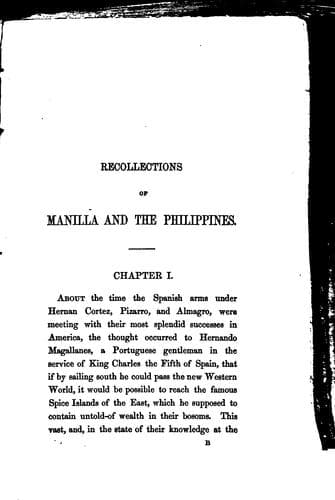
Recollections of Manilla and the Philippines: During 1848, 1849 and 1850MacMicking, Robert
History
Recollections of Manilla and the Philippines: During 1848, 1849 and 1850
MacMicking, Robert
Manila (Philippines); Philippines
Ropemaking is extensively carried on; the best cordage manufactured
in the islands being made from the fibres of the plantain-tree,
which is known in commerce by the name of Manilla hemp.
At Santa Mesa, in the neighbourhood of Manilla, the rope is spun up
by the aid of steam and good machinery, established there for the
purpose, and still carried on by an old shipmaster, who produces by
far the best rope of all that is made. It is also manufactured in
several other places by the common hand-spun process, but from being
unequally twisted when made by the hand, it is very much inferior to
what has been subjected in its manufacture to the uniform steadiness
of pull which the regularity of the steam machinery occasions, all of
which is consequently much more suited to stand a heavy strain, from
being twisted by it. The price of this rope is altogether dependent
on the price of hemp, as the value of the labour employed seldom
or never varies, although the raw material of which it is composed
constantly does; the usual addition made to the current price of hemp
being four dollars a pecul of 140 lbs. English, for the machine-made
rope, generally known as "Keating's patent cordage," supposing the
material so spun to be converted into an assorted lot of from one to
six-inch cordage.
The hemp employed in the manufacture of the patent cordage is generally
selected for its length of fibre, and lightness or whiteness of
colour; and when whale-lines are made, only the very finest lots of
hemp procurable at the time are used; but the charge for spinning
them is increased to six dollars a pecul, the extra labour being
so considerable, that even with the additional charge, the maker,
Mr. Keating, informed me that he was much better recompensed by the
larger sizes of the rope he spun than by these.
Bale or wool lashing is also made to a small extent for shipment to
Sydney, &c.; the quality of the hemp used in making it being of an
inferior description, and of a brownish colour. As it is very much
more loosely twisted than any other descriptions of rope made here,
the charge for spinning it is reduced to two dollars per pecul, and
the cost of it will be that amount added to the price of hemp at the
time of its manufacture.
The hand-spun rope never sells so well as that made by machinery,
and is usually obtainable at from one to two dollars per pecul less
than the latter, according as it is well or ill spun.
The export of rope varies from about 9,000 to 15,000 peculs annually;
by much the largest quantity usually going to the United States,
although there are considerable shipments to the Australian colonies,
China, Singapore, and Europe. A large quantity of it is also taken
by vessels visiting the port, for their own use.
The manufacture is encouraged by its freedom from any export duty,
to which hemp exported in an unmanufactured state is subject, to the
extent of 2 per cent.
Public-domain text, read in full here on John Shaqi.
Reviews
Reviews
No reviews yet
Be the first to share your thoughts on this work.
Elsewhere in the archive
Join the Discussion
Join the discussion
Sign in to leave a comment or review.
Sign InorCreate an account