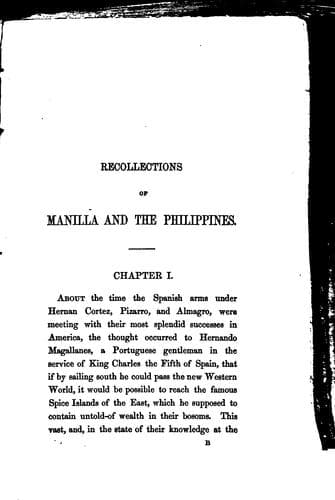
Recollections of Manilla and the Philippines: During 1848, 1849 and 1850MacMicking, Robert
History
Recollections of Manilla and the Philippines: During 1848, 1849 and 1850
MacMicking, Robert
Manila (Philippines); Philippines
The vessels engaged in the trade, being brigs or schooners, commonly
start from Manilla in March or April for Antique, Yloylo, or other
places, where they can complete a Sooloo cargo, after doing which they
steer for Zamboanga, to report their cargoes and provide themselves
with passports at the custom-house there, should they not have done
so at Manilla.
It is, however, only within these few years that these facilities have
been given to those engaged in the trade, as formerly the colonial
ships were forbidden, under a heavy penalty, to touch at any place
in the Philippines after clearing out for Sooloo from Manilla. In
spite of this law, however, few of those engaged in the trade had
virtue sufficient to obey it, and pass these places by, when it was
so very much to their interest to complete their cargoes there, which
they could not do elsewhere nearly so advantageously. And the only
consequence of this absurd old prohibition against their doing so,
was to involve many of them in long-pending and expensive lawsuits,
which have often ruined prosperous men.
Besides those _wise_ regulations, there existed some other forms
equally sensible. For instance, the traders of Bisayao province, who
send several small craft to Sooloo, which they are close to, were
compelled to make a tedious voyage to Manilla against the monsoon,
in order that they might report their cargo for Sooloo and get out
passes, after which they had to return all the way back again, and
at length were at liberty to steer for Sooloo.
However, these foolish restrictions were at length put a stop to, and
the trade encouraged, by the Government establishing a custom-house at
Zamboanga, where there is at all times a considerable military force.
The Sultan appears to be the most powerful nobleman in the country,
rather than the sovereign monarch of it. For although the chiefs of
the islands, or Datos, usually acquiesce in appearance to his will,
they do so more from fear of his power at the moment than with any
idea of his legitimate authority, and in effect they very seldom
comply with his decrees.
The entire people are slaves owned by the Sultan and these Datos,
who exercise over the unfortunate wretches the worst species of
tyrannical power; for as these nobles or _reguli_ are subject to
no law but there own caprice, if any slave displeases his master,
he can, without the slightest fear of having to give any account
of the circumstance to a living soul, draw his kris, and murder the
slave. Of course by so doing, however, he impoverishes himself, as he
loses the market price of the day for a slave; or should he murder a
slave belonging to some one else, a Dato is only expected to pay the
amount he was considered worth by his master, or to give another one
of his own in exchange for him.
Public-domain text, read in full here on John Shaqi.
Reviews
Reviews
No reviews yet
Be the first to share your thoughts on this work.
Elsewhere in the archive
Join the Discussion
Join the discussion
Sign in to leave a comment or review.
Sign InorCreate an account