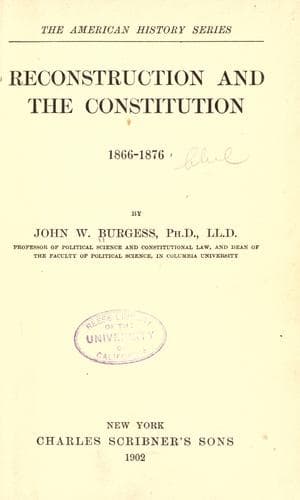
Reconstruction and the Constitution, 1866-1876Burgess, John William
History
Reconstruction and the Constitution, 1866-1876
Burgess, John William
Reconstruction (U.S. history, 1865-1877); United States -- Politics and government -- 1865-1877
The bill passed the Houses on the 13th of July, was presented to the
President for his signature on the 14th, and on the 19th he returned it
with a veto message to the House of Representatives. The President
contended in his argument that this new measure was not simply an
interpretation of the existing Reconstruction Acts, but was in many
respects a large advance upon them. The existing Acts, he contended,
made the reconstructed "State" governments at the South subject to
absolute military authority in many important respects, but not in all
respects, while the new measure proposed to extend the despotism of the
military commanders over everything. Against such a measure, in time of
peace, he protested as being in violation of every guaranty of {141}
individual liberty contained in the Constitution. He dwelt upon the
unfitness of military officers to discharge the duties and exercise the
powers pertaining naturally to civil office, and he pointed out the
inconsistency, as he thought, of the declaration of Congress that the
ten "State" governments at the South were illegal with the attempt of
Congress to carry on these _illegal_ "State" governments by "Federal
agency," when Congress had no power to carry on a _legal_ "State"
government through "Federal agency"; and he stopped, as he thought, the
way of escape from this argument by pointing out that the entire
legislation of Congress down to the passage of the Reconstruction Acts
distinctly involved the recognition of the ten communities now to be
put under absolute military rule in all respects as "States" of the
Union.
But the most vigorous and unanswerable part of the message was the
protest against the robbery of the constitutional powers of the
Executive by the attempt of Congress, in this measure, to confer some
of those powers upon other persons. The President expressed himself so
warmly upon this point, that the Republicans began to whisper around
their suspicions of sinister purposes on his part, just as if such a
declaration to Congress itself was not proof to the contrary. He said:
"Whilst I hold the chief executive authority of the United States,
whilst the obligation rests upon me to see that all the laws are
faithfully executed, I can never willingly surrender that trust or the
powers given for its execution. I can never give my assent to be made
responsible for the faithful execution of laws, and at the same time
surrender that trust and the powers which accompany it to any other
executive officer, high or low, or to any number of executive officers.
If this executive trust, vested by the Constitution in the President,
is to be taken from him {142} and vested in a subordinate officer, the
responsibility will be with Congress in clothing the subordinate with
unconstitutional power and with the officer who assumes its exercise."
[Sidenote: Ideas and suspicions about the meaning of the message.]
Public-domain text, read in full here on John Shaqi.
Reviews
Reviews
No reviews yet
Be the first to share your thoughts on this work.
Elsewhere in the archive
Join the Discussion
Join the discussion
Sign in to leave a comment or review.
Sign InorCreate an account