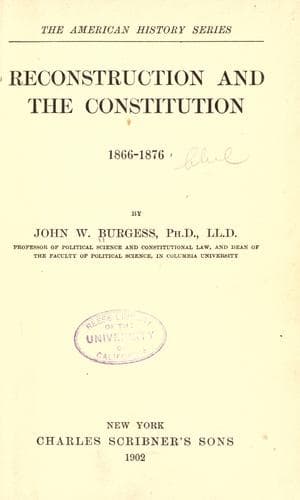
Reconstruction and the Constitution, 1866-1876Burgess, John William
History
Reconstruction and the Constitution, 1866-1876
Burgess, John William
Reconstruction (U.S. history, 1865-1877); United States -- Politics and government -- 1865-1877
[Sidenote: Fraudulent voting and unlawful voting.]
[Sidenote: The recall of Pope and the appointment of Meade in his
stead.]
The next step in the procedure was the submission of these
constitutions to the voters. The registration was effected in the same
manner as for the vote on the question of holding the conventions, and
the election of the delegates; and the elections were held, as before,
under the direction and control of the military commanders. The voting
upon the question of ratification came off first in Alabama. General
Pope had issued orders that the votes of persons registered in one
precinct might be received in another, and that "State" officers and
legislative members should be elected at the same election with the
vote on ratification, and by the same voters. There is no doubt that
the General only desired to secure the freedmen, who were then moving
about restlessly, in their right of suffrage under the Reconstruction
Acts, and to expedite the process of reconstruction so far as possible.
But he undoubtedly opened the door to fraudulent voting by offering
unrivalled opportunities for repeating, and he also violated the law
and practice under the Constitution of the United States in regard to
the qualified electors of "State" officers and legislators. Such
officers and legislators could have been constitutionally elected only
by the electors {152} designated in the constitution submitted for
adoption. The qualifications of the electors who vote upon the question
of the adoption of the first "State" constitution are necessarily fixed
by Congress, but Congress has no constitutional power to fix the
qualifications of the electors of "State" officers and legislators.
Neither has the constitutional convention, which frames the first
"State" constitution any such power, for the constitution which it
frames is only a proposition, and ratification by the electors
designated by Congress is necessary to its validity. Furthermore, any
resolution which it might pass ordering the election of "State"
officers or legislators by the electors designated by the Congressional
statute is only a proposition to those electors, which must be accepted
by them by a preliminary vote before they can proceed to the election
of such officers and legislators. The General certainly did not
understand these niceties of constitutional law and practice, and his
desire to hurry up the re-establishment of civil government was rather
laudable than otherwise. The President, however, who had in his
Attorney-General one of the ablest lawyers of the country, understood
well the constitutional limitations upon the General's powers and
duties. He recalled the reckless commander and sent the more
conservative Meade to take his place, December 28th, 1867.
[Sidenote: Rejection of the constitution in Alabama.]
Public-domain text, read in full here on John Shaqi.
Reviews
Reviews
No reviews yet
Be the first to share your thoughts on this work.
Elsewhere in the archive
Join the Discussion
Join the discussion
Sign in to leave a comment or review.
Sign InorCreate an account