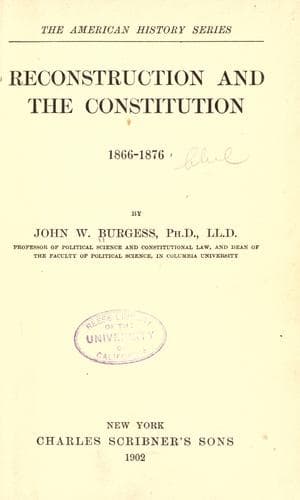
Reconstruction and the Constitution, 1866-1876Burgess, John William
History
Reconstruction and the Constitution, 1866-1876
Burgess, John William
Reconstruction (U.S. history, 1865-1877); United States -- Politics and government -- 1865-1877
In the original requirement that the vote to be effective must exceed
half of the registration, Congress was still upon the ground of correct
principle. When it left this ground it virtually accepted the principle
that republican "State" governments may be {154} legitimately created
by a minority of the lawful voters against the will of a majority of
the lawful voters, and that, too, not by allowing that minority to
demonstrate its political superiority to the majority by greater
intelligence, or shrewder management, or even by brute force, _but by
the aid of power coming from without_. Now this is not, in correct
political science, "State" government in a federal system, autonomous
local government, at all. It is provincial government in local affairs,
more or less complete as the necessity for the outside aid is more or
less continuous. The Republicans had denounced the Johnson "State"
governments upon the ground, among other grounds, that they were
minority governments, minority governments in the vague and uncertain
sense that not a majority of the adult males had been enfranchised, and
not in the clear and distinct and unmistakable sense that a minority of
the enfranchised, supported by the military power of the United States,
might impose its will upon a majority of the enfranchised. There was
nothing disloyal in the registered voters of Alabama giving Congress to
understand that a majority of them preferred the continuance of the
military régime, or the creation of a Territorial government for them
by Congress, to the "State" constitution offered them. But it was utter
self-stultification for Congress to take the ground that the Johnson
"State" governments were unrepublican because they did not enfranchise
all adult males of whatever race, color, or condition of mind or estate
and overthrow them on that ground, and then proceed to create new
"State" governments in their places upon the basis of a minority of the
already duly qualified and registered voters. No impartial student, at
this day, can view this terrible inconsistency in any other light than
that of a high political crime.
{155} [Sidenote: Ratification in Arkansas.]
While the Senate was proceeding with the bill, another of the Southern
communities was rapidly approaching the date fixed for voting upon the
proposed "State" constitution, viz., Arkansas. The bill was passed by
Congress the day before the voting began in Arkansas, but it was not
known in Arkansas that it had been passed until near the close of the
second day of the election. It could, however, be claimed that it was
applicable to the case, and it certainly made all figures unnecessary
except in regard to the actual voting. The "State" officers and
legislators under the constitution to be adopted were chosen at the
same time, by the Congressional electorate in Arkansas, and not by the
"State" electorate, created by the new constitution.
Public-domain text, read in full here on John Shaqi.
Reviews
Reviews
No reviews yet
Be the first to share your thoughts on this work.
Elsewhere in the archive
Join the Discussion
Join the discussion
Sign in to leave a comment or review.
Sign InorCreate an account