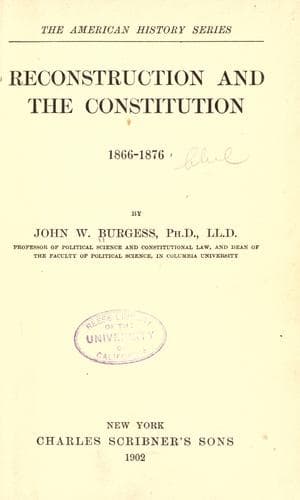
Reconstruction and the Constitution, 1866-1876Burgess, John William
History
Reconstruction and the Constitution, 1866-1876
Burgess, John William
Reconstruction (U.S. history, 1865-1877); United States -- Politics and government -- 1865-1877
Three days later, that is on the 25th, Congress provided in a single
act for the admission of the Senators and Representatives from the
other six reconstructed "States" to the national legislature in the
following language: "_Be it enacted, &c._, That each of the States of
North Carolina, South Carolina, Louisiana, Georgia, Alabama, and
Florida, shall be entitled and admitted to representation in Congress
as a State of the Union when the legislature of such State shall have
duly ratified the Amendment to the Constitution of the United States
proposed by the Thirty-ninth Congress, and known as Article XIV., upon
the following fundamental {199} conditions: That the constitution of
neither of said States shall ever be so amended or changed as to
deprive any citizen, or class of citizens, of the United States of the
right to vote in said State who are entitled to vote by the
constitution thereof, herein recognized, except as a punishment for
such crimes as are now felonies at common law, whereof they shall have
been duly convicted under laws equally applicable to all the
inhabitants of said State: _Provided_, that any alteration of said
constitutions may be made with regard to the time and place of
residence of voters." It was also further provided that the legislature
of Georgia should, by solemn public act, declare its assent to the
fundamental condition that the article of the new constitution of
Georgia prohibiting the courts within the "State" from entertaining any
suit against any resident of the "State" for any debt existing prior to
June 1st, 1865, and prohibiting the judicial and ministerial officers
of the "State" from executing any process in reference to such debts,
should be considered and treated as null and void.
[Sidenote: The veto of these bills by the President.]
The President had placed his veto on both of these bills. The veto of
the Arkansas bill bears the date of June 20th, and that of the other
bill bears the date of June 25th. There are parts of the President's
argument which are entirely convincing to any candid mind at the
present day. He pointed out that the fundamental condition imposed by
Congress, in all these cases, upon the admission of Senators and
Representatives to Congress, viz., that no change should ever be made
in the suffrage qualifications provided in these "State" constitutions
whereby any citizen or class of citizens of the United States having
the right to vote under these constitutions should be deprived of such
right, was an assumption of power by Congress to regulate a subject,
within the "States," which by the {200} existing Constitution of the
United States belonged exclusively to the "States," to each "State" for
itself.
Public-domain text, read in full here on John Shaqi.
Reviews
Reviews
No reviews yet
Be the first to share your thoughts on this work.
Elsewhere in the archive
Join the Discussion
Join the discussion
Sign in to leave a comment or review.
Sign InorCreate an account