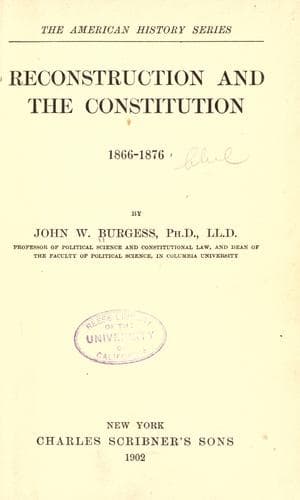
Reconstruction and the Constitution, 1866-1876Burgess, John William
History
Reconstruction and the Constitution, 1866-1876
Burgess, John William
Reconstruction (U.S. history, 1865-1877); United States -- Politics and government -- 1865-1877
Meanwhile the President had continued to ply the Congress with his
vetoes and messages and to address the country with his proclamations.
He had thought that he ought to be vindicated by being nominated by the
Democrats for the presidency, and had actually received sixty-five
votes on the first ballot. His failure before the convention ought to
have taught him that he was no longer a factor to be reckoned with in
the domain of politics, and that his proper course was to execute
quietly the functions of his office to the end of his term, and then
retire to private life. But he seemed to think that his political
opinions were still of great value, and in a very few days after the
adjournment of the Democratic convention he addressed a message to
Congress advising a most radical change in the structure of the
government by means of constitutional amendment. He therein recommended
that Congress should propose to the "States" so to amend the
Constitution as to provide for the election of the President and
Vice-President by a direct vote of the people, for the ineligibility of
these officers for a second term, for the designation of the members of
the Cabinet in a certain order, beginning with the Secretary of State,
as the persons to discharge the duties of the President in case of a
vacancy in the presidential office by the death, resignation or removal
of both the President and the Vice-President, for the election of the
Senators by the direct vote of the people, {214} and for the limitation
of the terms of the United States judges to a period of years. There
was sound reason for the third of these suggestions, the designation by
the Constitution of the Cabinet officers in a certain order as the
successors to the powers and duties of the President, when the country
might be without both a President and a Vice-President, and it has
since then been made law under the form of a statute of Congress.
[Sidenote: Congress and the President.]
But the Congress was not then in a mood to hear anything from Mr.
Johnson. Two days later, July 20th, the President vetoed the joint
resolution passed by the two Houses, excluding from the electoral
college in the coming presidential election the votes of "States"
lately in rebellion which should not have been reorganized under the
Reconstruction Acts of Congress. In this veto he went over his whole
argument once more against the constitutionality of these Acts and in
favor of his own method of Reconstruction. But the Congress treated the
message with contempt and promptly repassed the resolution.
[Sidenote: The President's last annual Message.]
Public-domain text, read in full here on John Shaqi.
Reviews
Reviews
No reviews yet
Be the first to share your thoughts on this work.
Elsewhere in the archive
Join the Discussion
Join the discussion
Sign in to leave a comment or review.
Sign InorCreate an account