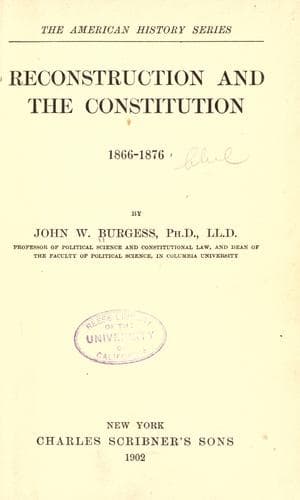
Reconstruction and the Constitution, 1866-1876Burgess, John William
History
Reconstruction and the Constitution, 1866-1876
Burgess, John William
Reconstruction (U.S. history, 1865-1877); United States -- Politics and government -- 1865-1877
Only once again did the Congress break over its apparent resolve to
ignore the President, and that was upon the occasion of his issue of
his universal and unconditional pardon and amnesty to all persons who
had participated, either directly or indirectly, in the rebellion, with
the restoration of all their rights, privileges and immunities under
the Constitution and the laws made in pursuance thereof. The date of
this document was December 25th, 1868. On the 5th of January, 1869, the
Senate called him to account for this by a {216} resolution calling
upon him "to transmit to the Senate a copy of any proclamation of
amnesty made by him since the last adjournment of Congress, and also to
communicate to the Senate by what authority of law the same was made."
The President replied on the 18th, sending a copy of his proclamation
of December 25th, 1868, and declaring that he issued it by authority of
the second section of Article second of the Constitution, which vested
in the President the power to grant reprieves and pardons for offences
against the United States, except in cases of impeachment, and in
accordance with precedents established by his predecessors in office,
Washington, Adams, Madison and Lincoln. The Senate did not say that he
had no right to claim any constitutional prerogative, and that he was
not worthy to act under precedents set by Washington, Adams, Madison,
and Lincoln, but most of the Senators evidently so thought. The
proclamation had no effect upon the qualifications for suffrage in the
face of the Reconstruction Acts and the "State" constitutions framed
and established in accordance with them. It was little more than the
bull against the comet.
[Sidenote: The President's veto of the Bill in regard to the colored
schools in the District of Columbia.]
As a sort of final stroke the President vetoed the bill concerning the
transfer of the control of the colored schools in the District of
Columbia, and the bill for raising the duties on imported copper and
copper ores. He gave excellent reasons for both of these vetoes, but
Congress had long ceased to be guided by reason in matters which
related to the President.
[Sidenote: The Fifteenth Amendment.]
Public-domain text, read in full here on John Shaqi.
Reviews
Reviews
No reviews yet
Be the first to share your thoughts on this work.
Elsewhere in the archive
Join the Discussion
Join the discussion
Sign in to leave a comment or review.
Sign InorCreate an account