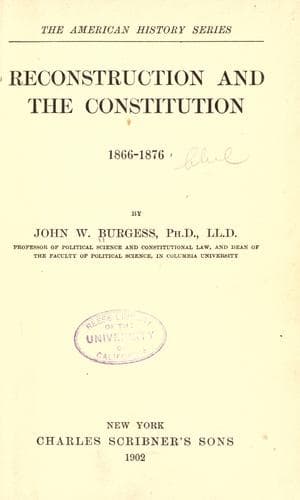
Reconstruction and the Constitution, 1866-1876Burgess, John William
History
Reconstruction and the Constitution, 1866-1876
Burgess, John William
Reconstruction (U.S. history, 1865-1877); United States -- Politics and government -- 1865-1877
Virginia, Texas and Georgia had been in no great hurry, as we have
seen, to exchange military government exercised by the white officers
of the United States army for "State" government under the electorate
proposed in the Reconstruction Acts. In this they were wise. The army
officers did not, as a rule, sympathize with the radical {248}
movements of the Republicans in Congress, and they so executed the
duties imposed upon them as to cause the least suffering and
inconvenience. Their rule, though exercised under a repellent title,
was in fact far milder than, and far preferable to, the civil
government of the adventurer and the negro. They mingled socially with
the old families, and, in many cases, married their fair daughters. The
common soldiers from the Northern "States" also fraternized with their
race relatives in the South. They did not fancy the black soldiers
either of the regular army or the "State" militia, and many were the
cases in which they intervened between the defenceless ex-Confederates
and the brutal blacks in blue. It is even said by men who have every
opportunity to know that many of them doffed their uniforms on election
day, went to the polls, and voted the Democratic ticket.
In spite of the threats of Congress, and the ever-increasing conditions
imposed by that body upon the permission to resume the "State" status,
these three communities held out under military rule until so many of
their leading citizens had been amnestied by Congress and made again
eligible to office and mandate, and until so much better provisions
concerning the enfranchisement of the ex-Confederates had been secured,
as to put them in a far better position to resume "State" government
than was the case two years before. Moreover, these communities had
larger white than black populations. After their full restoration,
consequently, Virginia and Georgia escaped largely the suffering
experienced by most of the others, and Texas also managed to pull
through the years from 1870 to 1874 with only about a four-fold
increase of taxation, and the creation of a debt of only about
5,000,000 of dollars, when she reached the period of union of almost
all her best citizens in the {249} Democratic party, which, in the
election of Richard Coke as Governor in 1874, and of a majority of the
legislative members, permanently triumphed in Texas. Mississippi also
had held back in 1868 and 1869, as we have seen, in order to secure
better terms for the ex-Confederates in the enfranchising and
disfranchising provisions of the "State" constitution, and by doing so
had accomplished this result. But Mississippi was one of the three
Southern communities in which the negro population far outnumbered the
white. Mississippi was not, for this reason chiefly, so fortunate as
Virginia, Texas and Georgia. She was obliged, with South Carolina and
Louisiana, to pass through the fiery furnace in order to fuse the
respectable white elements in her population into a single political
Public-domain text, read in full here on John Shaqi.
Reviews
Reviews
No reviews yet
Be the first to share your thoughts on this work.
Elsewhere in the archive
Join the Discussion
Join the discussion
Sign in to leave a comment or review.
Sign InorCreate an account