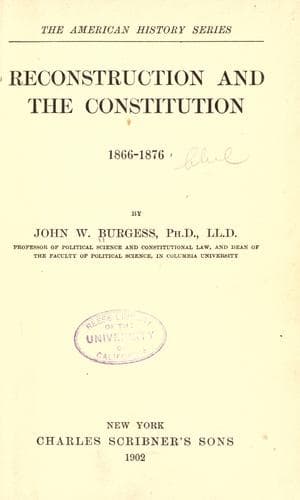
Reconstruction and the Constitution, 1866-1876Burgess, John William
History
Reconstruction and the Constitution, 1866-1876
Burgess, John William
Reconstruction (U.S. history, 1865-1877); United States -- Politics and government -- 1865-1877
In the election, they swept all of the Northern "States" by heavy
popular majorities, and with their election machinery in the Southern
"States" they captured a majority of these also. In those Southern
"States" which were free from carpet-bag negro rule the Greeley
electors were chosen, that is in Maryland, Kentucky, Missouri,
Tennessee, Georgia and Texas. In the North, a very large number of
Democrats had failed to go to the polls. They could hardly have elected
Greeley, however, had they all voted for him. They were pretty sure of
this, and they took the opportunity of administering a rebuke to their
chiefs for not nominating candidates who were members of their own
party.
[Sidenote: The effect of the triumph of the Republicans.]
While there is no doubt that the re-election of General Grant, and the
election of a strong Republican majority in Congress, quieted the mind
of the North, there is also no doubt that they caused great {268}
discouragement among the white people of the South, since they operated
as an encouragement to the adventurers and the negroes to persevere in
their corrupt and conscienceless management of the "State" governments.
In several of the reconstructed "States" the Democrats had made strong
efforts to secure control of the "State" governments. The Amnesty Act
of May 22d, 1872, had removed the disqualifications of the Fourteenth
Amendment from all the Southern leaders, except such as had been
members of the Thirty-sixth and Thirty-seventh Congresses, or had held
judicial, military, naval, or diplomatic office under the United
States, or had been heads of departments in ministerial office. A large
number of these leaders had thus been placed in a position to
participate as candidates for office and legislative position in the
election, and to aid greatly in the work of rescuing their "States"
from negro Republican rule. In Alabama and Louisiana they had very
nearly succeeded. In Alabama they had elected the Governor and a
majority of the members to the lower house of the legislature in the
autumn of 1870, and in 1872 they claimed to have elected a majority of
the members to both houses.
[Sidenote: Events in Alabama.]
In Alabama, the Democratic members-elect of the legislature convened in
the capitol, and the Republican members-elect in the court-house. The
Democratic Governor, Lindsay, recognized the Democratic legislature,
and the Democratic legislature then canvassed the votes for Governor
and declared the Republican candidate, D. P. Lewis, elected. Lewis then
recognized the Republican legislature, and telegraphed to Opelika for
United States soldiers to come to Montgomery. They arrived by the next
train, and, backed by these, the Governor and his friends, in and {269}
out of the legislature, succeeded in constituting a legislature with a
small Republican majority in both houses; and the whites fell back
again under black rule, discouraged and exhausted by the exertions and
the failure to escape from it.
Public-domain text, read in full here on John Shaqi.
Reviews
Reviews
No reviews yet
Be the first to share your thoughts on this work.
Elsewhere in the archive
Join the Discussion
Join the discussion
Sign in to leave a comment or review.
Sign InorCreate an account