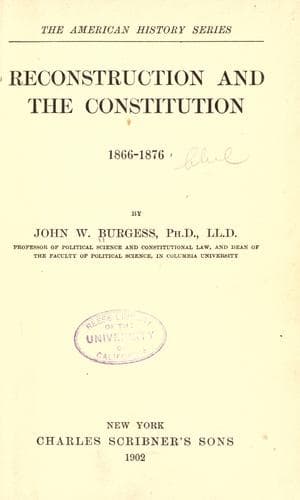
Reconstruction and the Constitution, 1866-1876Burgess, John William
History
Reconstruction and the Constitution, 1866-1876
Burgess, John William
Reconstruction (U.S. history, 1865-1877); United States -- Politics and government -- 1865-1877
The essential provisions of the bill were, first, the creation of a
Commission composed of five members of the House of Representatives,
five members of the Senate, and five Justices of the Supreme Court of
the United States, the members from the House to be chosen by the
House, the members from the Senate to be chosen by the Senate, while
the Justices of the Supreme Court from the first, third, eighth and
ninth circuits were designated in the bill, and they were authorized to
select a fifth from among the other members of the Court; second, the
fixing of the rule that the electoral vote of any "State" from which
only a single return had been received should be counted unless _both_
Houses should decide otherwise, and of the other rule that when more
than one return had been received from any "State," the Commission
should forthwith decide which return should be counted, and this return
should be counted unless _both_ Houses should reject the decision, or
order otherwise; and third, the reservation of any right existing under
the Constitution and laws to question before the courts of the United
States the titles of the persons who should be declared elected
President and Vice-President to these respective offices. The bill was
subjected to a most thorough discussion in _both_ Houses. It passed the
Senate on the 24th of January by a vote of forty-seven to seventeen.
Twenty-one {286} Republicans and twenty-six Democrats voted in favor of
it, and sixteen Republicans and one Democrat voted against it. It
passed the House on the 26th by a vote of one hundred and ninety-one to
eighty-six. Thirty-three Republicans and one hundred and fifty-eight
Democrats voted for it, and sixty-eight Republicans and eighteen
Democrats voted against it. It is certainly fair, therefore, to call it
a Democratic measure. The President signed the bill, nevertheless, on
the 29th.
[Sidenote: The members of the Commission.]
The Senate immediately chose Messrs. Edmunds, Frelinghuysen and Morton,
Republicans, and Messrs. Bayard and Thurman, Democrats, to represent it
upon the Commission, and the House chose Messrs. Garfield and Hoar,
Republicans, and Messrs. Abbott, Hunton and Payne, Democrats. The
Justices of the Supreme Court designated by the bill as members of the
Commission were Messrs. Clifford, Strong, Miller and Field. Strong and
Miller were understood to be Republicans, and Clifford and Field
Democrats. Upon these four the duty was imposed to select the fifth
Justice.
[Sidenote: The fifth Justice.]
Public-domain text, read in full here on John Shaqi.
Reviews
Reviews
No reviews yet
Be the first to share your thoughts on this work.
Elsewhere in the archive
Join the Discussion
Join the discussion
Sign in to leave a comment or review.
Sign InorCreate an account