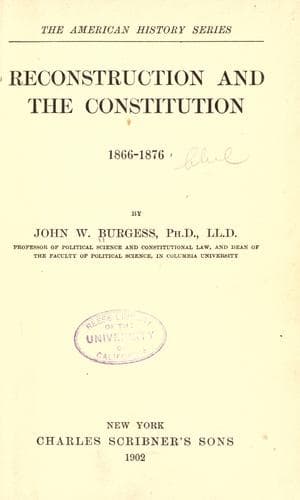
Reconstruction and the Constitution, 1866-1876Burgess, John William
History
Reconstruction and the Constitution, 1866-1876
Burgess, John William
Reconstruction (U.S. history, 1865-1877); United States -- Politics and government -- 1865-1877
This was what is now called "a twist of the lion's tail." It was
something of a twist, although it was accompanied with the offer of the
olive branch, instead of the sword. It was effective, even more
effective for the conciliatory tone of the final paragraph. Moreover,
with the German armies encamped around Paris and throughout France, the
affairs of Continental Europe were too unsettled and precarious for
Great Britain to run the risk of any serious complications with the
United States.
[Sidenote: Sir John Rose's mission to the United States.]
[Sidenote: The Joint High Commission.]
Accepting the President's message as an invitation to renew
negotiations, the British Government, at the beginning of the next year
(1871), sent Sir John Rose to Washington to sound the President in
regard to the matter. The President greeted his advances with great
cordiality, and on the 26th of the month (January), Sir Edward
Thornton, the British Minister to the United States, formally proposed
to the Hon. Hamilton Fish, the Secretary of State, the appointment of a
Joint High {307} Commission, to consist of five persons representing
each Government, to sit at Washington, for the purpose of settling the
questions between the two Governments relative to Great Britain's North
American possessions. Mr. Fish immediately expressed the willingness of
his Government to enter upon the negotiation, provided the differences
growing out of the events of the Civil War should be included among the
subjects to be considered. The British Government accepted Mr. Fish's
proviso, and the respective Governments proceeded to appoint the
members of the Commission. President Grant designated Hamilton Fish,
Ebenezer R. Hoar, Justice Samuel Nelson, Robert C. Schenck and George
H. Williams. Her Majesty selected Earl de Grey and Ripon, Sir John
Macdonald, Sir Stafford Northcote, Sir Edward Thornton and Professor
Mountague Bernard. These eminent gentlemen proceeded immediately upon
their momentous undertaking, and on the 8th of May (1871) concluded the
treaty between the two Governments, known as the Treaty of Washington,
which was duly ratified, and on the 4th of July proclaimed to the
world.
[Sidenote: The Treaty of Washington.]
The first eleven articles of this agreement relate to the claims for
damages arising from the incidents of the Civil War, known as the
Alabama Claims. This was the subject of transcendent importance in the
Treaty; this was the subject which was, by these articles, referred to
the Court of Arbitration to sit at Geneva.
They contain, in the first place, an expression of regret for the
escape of the Confederate vessels from British ports and for the
depredations committed by them.
Public-domain text, read in full here on John Shaqi.
Reviews
Reviews
No reviews yet
Be the first to share your thoughts on this work.
Elsewhere in the archive
Join the Discussion
Join the discussion
Sign in to leave a comment or review.
Sign InorCreate an account