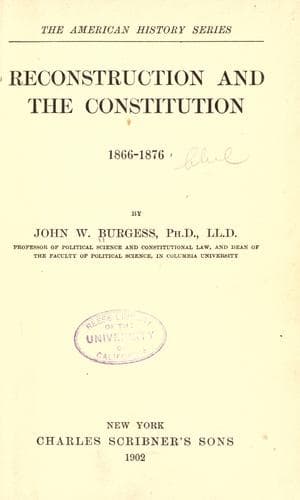
Reconstruction and the Constitution, 1866-1876Burgess, John William
History
Reconstruction and the Constitution, 1866-1876
Burgess, John William
Reconstruction (U.S. history, 1865-1877); United States -- Politics and government -- 1865-1877
In 1861 Anson Burlingame, a citizen of the United States and a resident
of Massachusetts, was sent as Minister of the United States to China.
He was a diplomatist of much skill, and he succeeded in making such a
deep impression upon the Emperor of China that the latter, on his
resignation as Minister of the United States to China in 1867, made him
Envoy Extraordinary from China to the United States and the European
states for the purpose of securing treaties of amity and commerce
between China and the states of the civilized world. He came
immediately to the United States and negotiated with Mr. Seward, the
Secretary of State of the United States, the Treaty of July 28th, 1868,
whereby freedom of emigration and immigration between China and the
United States was established, upon the principle of the "inherent and
inalienable right of man to change his home and allegiance" expressly
subscribed to by the United States and China in the Treaty; the
residence of Chinese consuls in the ports of the United States, with
the same privileges and immunities as the British and Russian consuls
enjoyed in said ports, was agreed to; and freedom of religion for
citizens of {323} the United States in China, and Chinese converts to
the Christian religion in China, and for Chinese subjects in the United
States, was mutually pledged. This Treaty was heralded at the time as
being an immense advance in bringing China into close sympathy with
modern civilization. But very soon the "labor element," as it assumes
to call itself, in the United States, began to find fault with the
liberal provisions upon the subject of emigration and immigration, and
has succeeded in forcing the Government of the United States back from
its ideal position to the old ground of national exclusiveness. The
example set by the United States has been accepted by the Chinese
Government as a justification of its old methods, and as an excuse for
dropping back into them in great measure.
[Sidenote: The attempt to annex the Dominican Republic to the United
States.]
At the moment of General Grant's accession to the presidency there was
civil commotion in the Dominican Republic. Buenaventura Baez was the
legal President of the Republic, but he had lost the support of a very
large proportion of the population, who were following a leader named
Cabral. Cabral and his party were so strong that Baez feared the
overthrow of his government, and sought to avert it by proposing
annexation to the United States.
[Sidenote: The Treaty.]
Public-domain text, read in full here on John Shaqi.
Reviews
Reviews
No reviews yet
Be the first to share your thoughts on this work.
Elsewhere in the archive
Join the Discussion
Join the discussion
Sign in to leave a comment or review.
Sign InorCreate an account