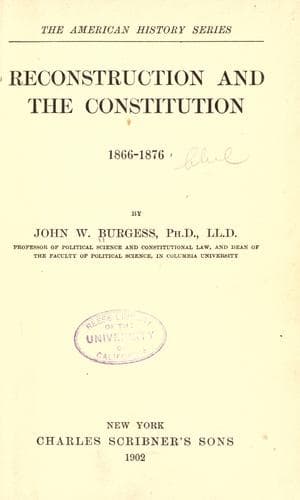
Reconstruction and the Constitution, 1866-1876Burgess, John William
History
Reconstruction and the Constitution, 1866-1876
Burgess, John William
Reconstruction (U.S. history, 1865-1877); United States -- Politics and government -- 1865-1877
From the point of view of to-day it is difficult to see why the
President was not right. There is no doubt that the Freedmen's Bureau
with its powers, jurisdiction and charities, was a far greater source
of irritation in the South than was the presence of the United States
army. While its superior officers were generally men of ability and
character, a large number of the subalterns were canting hypocrites and
outright thieves. They kept the negroes in a state of idleness, beggary
and unrest, and made them a constant danger to the life and property of
the whites; and their veritable tyranny over the white population did
more to destroy Union sentiment among the whites and make them regard
the United States Government in a hostile light than anything which had
happened during the whole course of the rebellion. It was an
institution which ought to have been dispensed with the instant that
the necessity which called it into existence passed away. The law of
March 3d, 1865, had still about eight months to run, and Congress would
be in session again four months before it would expire. There was ample
opportunity for prolonging the law, and that law, it was to be
presumed, was less needed in 1866 than in 1865. It took all of the
party discipline of the Republicans to prevent sufficient disaffection
in their ranks to sustain the President's veto. On the merits of the
question alone they could not have done it. They were in error, and
many of them knew it, but they were now in to fight the President and
they must stand together.
{90} [Sidenote: The veto overridden.]
The veto of the bill was dated July 16th, and the two Houses repassed
it over the veto on the same day. The new law was to be executed
through the War Department, as the original measure had been, and the
Secretary of War had begun to manifest that indecent hostility to the
President which disgraced the last years of the Administration. The
President was largely cut off from even the knowledge of what was
taking place in the operations of the Freedmen's Bureau, and Mr.
Stanton now managed it in such a manner, whether intentional or not, as
to cause the greatest possible friction between the Government and the
whites of the South, and thus to retard the process of Reconstruction
and to destroy what had been already accomplished in that direction.
[Sidenote: Disaffection in the Cabinet.]
[Sidenote: Stanton's attitude toward the President.]
Public-domain text, read in full here on John Shaqi.
Reviews
Reviews
No reviews yet
Be the first to share your thoughts on this work.
Elsewhere in the archive
Join the Discussion
Join the discussion
Sign in to leave a comment or review.
Sign InorCreate an account