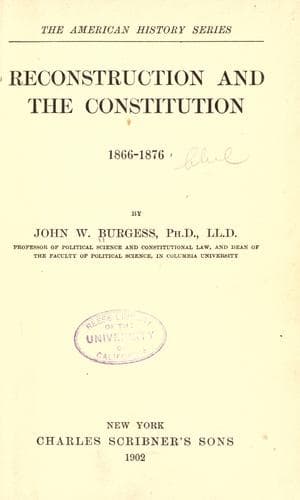
Reconstruction and the Constitution, 1866-1876Burgess, John William
History
Reconstruction and the Constitution, 1866-1876
Burgess, John William
Reconstruction (U.S. history, 1865-1877); United States -- Politics and government -- 1865-1877
Besides Stanton, three other members of the Cabinet had showed their
disaffection toward the President's policy. They were Mr. Speed, the
Attorney-General, Mr. Dennison, the Postmaster-General, and Mr. Harlan,
the Secretary of the Interior. During the course of the month (July)
these three gentlemen resigned their offices, and were replaced by Mr.
Stanbery, Mr. A. W. Randall, and Mr. O. H. Browning. Their sense of
propriety would not permit them to retain high office under the
President while differing with him so widely in regard to the
fundamental question of Reconstruction. Mr. Stanton, however, took a
different view of his duty. He seemed to feel that he was under
obligations to his country to remain in the President's Cabinet, at the
head of the most important branch of the Administration at that moment,
and protect the country against the purposes of the President. He was
sustained in this view by the Republican majority in Congress, which
soon entered upon its course of depriving {91} the President of his
military control even, by transferring his functions to the Secretary
of War and the General of the army. To the men of the present day, Mr.
Stanton's conduct appears, at least, lacking in a proper sense of
delicacy. It may be regarded in an even more serious light. It may be
looked upon as a conspiracy with the Republican majority in Congress to
rob the President of his constitutional prerogatives, to change the
form of government from the presidential system to the parliamentary
system of administration. It is difficult to find any sufficient
defence for Mr. Stanton's course. It is impossible to clear him of the
appearance of great egotism or of great greed of office, in not
resigning along with his dissatisfied colleagues.
The President knew of this difference of feeling between himself and
his War Secretary at the time of his reorganization of the Cabinet in
July, and would undoubtedly have been glad to receive his resignation,
but he did not ask for it. The newspapers which sustained the
Administration did, however, and predicted that it would be
forthcoming. The Republican leaders, on the other hand, encouraged
Stanton to hold on to the office, and represented to him that the
welfare of his country demanded the sacrifice of his personal feelings
in the matter.
[Sidenote: The opinion and feeling in the North concerning the
condition of things in the South.]
Public-domain text, read in full here on John Shaqi.
Reviews
Reviews
No reviews yet
Be the first to share your thoughts on this work.
Elsewhere in the archive
Join the Discussion
Join the discussion
Sign in to leave a comment or review.
Sign InorCreate an account