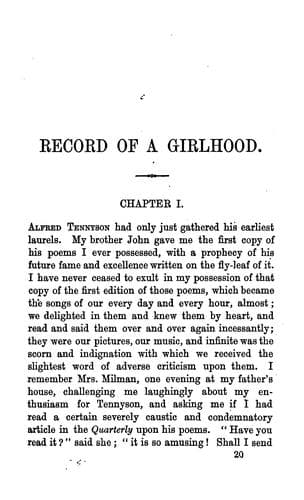
"To-day has waved its parting wings,
To join the days before it;
And as for what the morning brings,
The morning's mist hangs o'er it."
It was delightful to hear him and my mother talk together, and their
disputes, though frequent, seemed generally extremely amicable, and as
diverting to themselves as to us. On one occasion he ended their
discussion (as to whether some lady of their acquaintance had or had not
gone somewhere) by a vehement declaration which passed into a proverb in
our house: "Yes, yes, she did; for a woman will go anywhere, at any
time, with anybody, to see any thing--especially in a gig." Those were
days in which a gig was a vehicle the existence of which was not only
recognized in civilized society, but supposed to confer a diploma of
"gentility" upon its possessor.
Horace Twiss was one of the readiest and most amusing talkers in the
world, and when he began to make his way in London society, which he
eventually did very successfully, ill-natured persons considered his
first step in the right direction to have been a repartee made in the
crush-room of the opera, while standing close to Lady L----, who was
waiting for her carriage. A man he was with saying, "Look at that fat
Lady L----; isn't she like a great white cabbage?" "Yes," answered
Horace, in a discreetly loud tone, "she _is_ like one--all heart, I
believe." The white-heart cabbage turned affably to the rising
barrister, begged him to see her to her carriage, and gave him the
_entree_ of H---- House. Lord Clarendon subsequently put him in
Parliament for his borough of Wootton-Basset, and for a short time he
formed part of the ministry, holding one of the under-secretaryships. He
was clever, amiable, and good-tempered, and had every qualification for
success in society.
He had married a Miss Searle, one of his mother's pupils at the
fashionable Bath boarding-school, the living image of Scott's Fenella,
the smallest woman that I have ever seen, with fairy feet and tiny
hands, the extraordinary power of which was like that of a steel talon.
On one occasion, when Horace Twiss happened to mention that his bright
little spark of a wife sat working in his library by him, while he was
engaged with his law or business papers, my mother suggested that her
conversation must disturb him. "Oh, she doesn't talk," said he, "but I
like to hear the scissors fall," a pretty conjugal reply, that left a
pleasant image in my mind. His only child by her, a daughter, married
first Mr. Bacon, then editor of the _Times_, and, after his death, John
Delane, who succeeded him in that office and still holds it; so that her
father said "she took the _Times_ and Supplement."
Public-domain text, read in full here on John Shaqi.
Reviews
Reviews
No reviews yet
Be the first to share your thoughts on this work.
Elsewhere in the archive
Join the Discussion
Join the discussion
Sign in to leave a comment or review.
Sign InorCreate an account