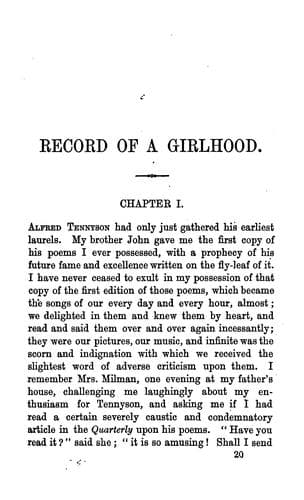
fabrics she wore, or of the fashion in which they were made. She wore no
colors, black and gray being the only shades I ever saw her in; and her
dress, bare and bald of every ornament, was literally only a covering
for her body; but it was difficult to find cashmere fine enough for her
scanty skirts, or cloth perfect enough for her short spencers, or lawn
clear and exquisite enough for her curious collars and cuffs of
immaculate freshness.
I remember a similar peculiarity of dress in a person in all other
respects the very antipodes of my friend H----. My mother took me once
to visit a certain Miss W----, daughter of a Stafford banker, her very
dear friend, and the godmother from whom I took my second name of Anne.
This lady inhabited a quaint, picturesque house in the oldest part of
the town of Stafford. Well do I remember its oak-wainscoted and
oak-paneled chambers, and the fine old oak staircase that led from the
hall to the upper rooms; also the extraordinary abundance and delicacy
of our meals, particularly the old-fashioned nine o'clock supper, about
every item of which, it seemed to me, more was said and thought than
about any food of which I ever before or since partook. It was in this
homely palace of good cheer that a saying originated, which passed into
a proverb with us, expressive of a rather _un_nice indulgence of
appetite.
One of the ladies, going out one day, called back to the servant who was
closing the door behind her: "Tell the cook not to forget the
sally-lunns" (a species of muffin) "for tea, well greased on both sides,
and we'll put on our cotton gowns to eat them."
The appearance of the mistress of this mansion of rather obsolete
luxurious comfort was strikingly singular. She was a woman about sixty
years old, tall and large and fat, of what Balzac describes as "un
embonpoint flottant," and was habitually dressed in a white linen
cambric gown, long and tending to train, but as plain and tight as a bag
over her portly middle person and prominent bust; it was finished at the
throat with a school-boy's plaited frill, which stood up round her heavy
falling cheeks by the help of a white muslin or black silk cravat. Her
head was very nearly bald, and the thin, short gray hair lay in distant
streaks upon her skull, white and shiny as an ostrich egg, which on the
rare occasions of her going out, or into her garden, she covered with a
man's straw or beaver hat.
Public-domain text, read in full here on John Shaqi.
Reviews
Reviews
No reviews yet
Be the first to share your thoughts on this work.
Elsewhere in the archive
Join the Discussion
Join the discussion
Sign in to leave a comment or review.
Sign InorCreate an account