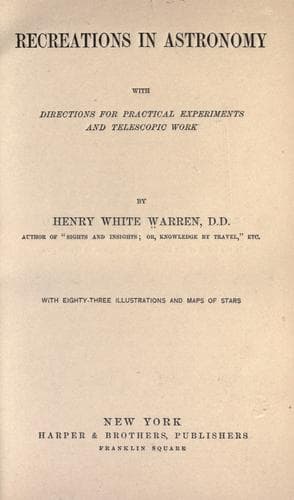
Recreations in Astronomy: With Directions for Practical Experiments and Telescopic WorkWarren, Henry White
Religion
Recreations in Astronomy: With Directions for Practical Experiments and Telescopic Work
Warren, Henry White
Astronomy
We find some stars double, others triple, quadruple, octuple, and
multiple. It is an extension of the same principles that govern
our system. Some of these suns are so far asunder that they can
swing their Neptunes between them, with less perturbation than
Uranus and Neptune have in ours. Light all our planets, and there
would be a multiple star with more or less suns seen,
[Page 214]
according to the power of the instrument. Perhaps the octuple star
s in Orion differs in no respect from our system, except in the
size and distance of its separate bodies, and less cooling, either
from being younger, or from the larger bodies cooling more slowly.
Suns are of all ages. Infinite variety fills the sky. It is as
preposterous to expect that every system or world should have analogous
circumstances to ours at the present time, as to insist that every
member of a family should be of the same age, and in the same state
of development. There are worlds that have not yet reached the
conditions of habitability by men, and worlds that have passed
these conditions long since. Let them go. There are enough left,
and an infinite number in the course of preparation. Some are fine
and lasting enough to be eternal mansions.
_Colored Stars._
In the cloudy morning we get only red light, but the sun is white.
So Aldebaran and Betelguese may be girt by vapors, that only the
strong red rays can pass. Again, an iron moderately heated gives
out dull red light; becoming hotter, it emits white light. Sirius,
Regulus, Vega, and Spica may be white from greater intensity of
vibration. Procyon, Capella, and Polaris are yellow from less intensity
of vibration. Again, burn salt in a white flame, and it turns to
yellow; mix alcohol and boracic acid, ignite them, and a beautiful
green flame results; alcohol and nitrate of strontia give red flame;
alcohol and nitrate of barytes give yellow flame. So the composition
of a sun, or the special development of anyone substance thereof
at any time, may determine the color of a star.
[Page 215]
The special glory of color in the stars is seen in the marked contrasts
presented in the double and multiple stars. The larger star is
usually white, still in the intensity of heat and vibration; the
others, smaller, are somewhat cooled off, and hence present colors
lower down the scale of vibration, as green, yellow, orange, and
even red.
That stars should change color is most natural. Many causes would
produce this effect. The ancients said Sirius was red. It is now
white. The change that would most naturally follow mere age and
cooling would be from white, through various colors, to red. We are
charmed with the variegated flowers of our gardens of earth, but
he who makes the fields blush with flowers under the warm kisses of
the sun has planted his wider gardens of space with colored stars.
"The rainbow flowers of the footstool, and the starry flowers of
the throne," proclaim one being as the author of them all.
_Clusters of Stars._
Public-domain text, read in full here on John Shaqi.
Reviews
Reviews
No reviews yet
Be the first to share your thoughts on this work.
Elsewhere in the archive
Join the Discussion
Join the discussion
Sign in to leave a comment or review.
Sign InorCreate an account