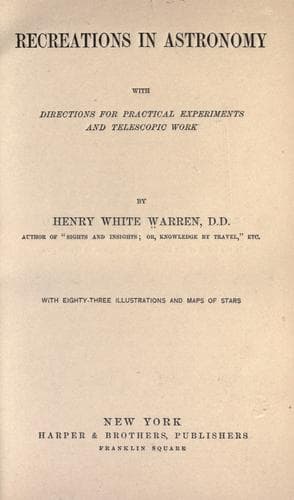
Recreations in Astronomy: With Directions for Practical Experiments and Telescopic WorkWarren, Henry White
Religion
Recreations in Astronomy: With Directions for Practical Experiments and Telescopic Work
Warren, Henry White
Astronomy
[Illustration: Fig. 81.--Constellation Lyra, showing place of the
Ring Nebula.]
Mira, or the Wonderful, in the Whale (Fig. 68), is easily found when
visible. Align from Capella to the Pleiades, and as much farther,
and four stars will be seen, situated thus:
*
* * *
The right-hand one is Mira. For half a month it shines as a star
of the second magnitude. Then for three months it fades away, and
lost to sight; going down even to the eleventh magnitude. But after
five months its resurrection morning mes; and in three months
more--eleven months in all--our Wonderful is in its full glory
in the heavens. It its period and brilliancy are also variable.
The star Megrez, d in the Great Bear, has been growing dim [Page
222] for a century. In 1836 Betelguese was exceedingly variable, and
continued so till 1840, when the changes became much less
conspicuous. Algol (Fig. 68) has been already referred to. This
slowly winking eye is of the second magnitude during 2d. 14h. Then
it dozes off toward sleep for 4h. 24m., when it is nearly invisible.
It wakes up during the same time; so that its period from maximum
brilliancy to the same state again is 2d. 20h. 48m. Its recognizable
changes are within five or six hours. As I write, March 25th, 1879,
Algol gives its minimum light at 9h. 36m. P.M. It passes fifteen
minima in 43d. 13m. There will therefore be another minimum May 7th,
at 9h. 49m. Its future periods are easy to estimate. Perhaps it has
some dark body revolving about it at frightful speed, in a period of
less than three days. The period of its variability is growing
shorter at an increasing rate. If its variability is caused by a
dark body revolving about it, the orbit of that body is contracting,
and the huge satellite will soon, as celestial periods are reckoned,
commence to graze the surface of the sun itself, rebound again and
again, and at length plunge itself into the central fire. Such an
event would evolve heat enough to make Algol flame up into a star of
the first magnitude, and perhaps out-blaze Sirius or Capella in our
winter sky.
None of the causes for these changes we have been able to conjecture
seem very satisfactory. The stars may have opaque planets revolving
about them, shutting off their light; they may rotate, and have
unequally illuminated sides; they may revolve in very elliptical
orbits, so as to greatly alter their distance from us; they may
be so situated in regard to zones of meteorites as [Page 223] to
call down periodically vast showers; but none or all of these
suppositions apply to all cases, if they do to any.
_Temporary, New, and Lost Stars._
Public-domain text, read in full here on John Shaqi.
Reviews
Reviews
No reviews yet
Be the first to share your thoughts on this work.
Elsewhere in the archive
Join the Discussion
Join the discussion
Sign in to leave a comment or review.
Sign InorCreate an account