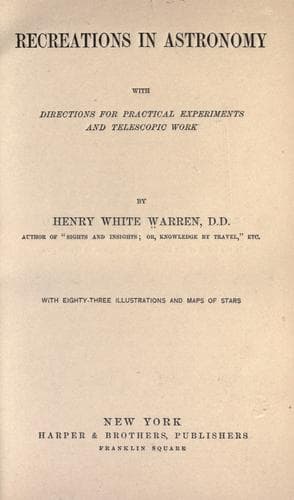
Recreations in Astronomy: With Directions for Practical Experiments and Telescopic WorkWarren, Henry White
Religion
Recreations in Astronomy: With Directions for Practical Experiments and Telescopic Work
Warren, Henry White
Astronomy
Our atom is not found yet. Many are the ways of searching for it
which we cannot stop to consider. We will pass in review the properties
with which materialists preposterously endow it. It is impenetrable
and indivisible, though some atoms are a hundred times larger than
others. Each has definite shape; some one shape, and some another.
They differ in weight, in quantity of combining power, in quality
of combining power. They combine with different substances, in
certain exact assignable quantities. Thus one atom of hydrogen
combines with eighty of bromine, one hundred and sixty of mercury,
two hundred and forty of boron, three hundred and twenty of silicon,
etc. Hence our atom of hydrogen must have power to count, or at
least to measure, or be cognizant of bulk. Again, atoms are of
different sorts, as positive or negative to electric currents.
They have power to take different shapes with different atoms in
crystallization; that is, there is a power in them, conscious or
otherwise, that the same bricks shall make themselves into stables
or palaces, sewers or pavements, according as the mortar varies.
"No, no," you cry out; "it is only according as the builder varies
his plan." There is no need to rehearse these powers much further;
though not one-tenth of the supposed innate properties of this
infinitesimal infinite have been recited--properties which are
expressed by the words atomicity, quantivilence, monad, dryad,
univalent, perissad, quadrivalent, and twenty other terms, each
expressing some endowment of power in this in visible atom. Refer
to one more presumed ability, an ability [Page 257] to keep
themselves in exact relation of distance and power to each other,
without touching.
It is well known that water does not fill the space it occupies.
We can put eight or ten similar bulks of different substances into
a glass of water without greatly increasing its bulk, some actually
diminishing it. A philosopher has said that the atoms of oxygen
and hydrogen are probably not nearer to each other in water than
one hundred and fifty men would be if scattered over the surface
of England, one man to four hundred square miles.
The atoms of the luminiferous ether are infinitely more diffused,
and yet its interactive atoms can give four hundred millions of
light-waves a second. And now, more preposterous than all, each
atom has an attractive power for every other atom of the universe.
The little mote, visible only in a sunbeam streaming through a
dark room, and the atom, infinitely smaller, has a grasp upon the
whole world, the far-off sun, and the stars that people infinite
space. The Sage of Concord advises you to hitch your wagon to a
star. But this is hitching all stars to an infinitesimal part of
a wagon. Such an atom, so dowered, so infinite, so conscious, is
an impossible conception.
Public-domain text, read in full here on John Shaqi.
Reviews
Reviews
No reviews yet
Be the first to share your thoughts on this work.
Elsewhere in the archive
Join the Discussion
Join the discussion
Sign in to leave a comment or review.
Sign InorCreate an account