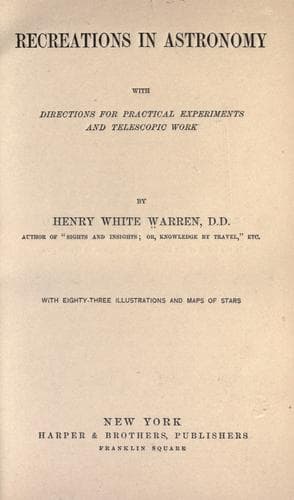
Recreations in Astronomy: With Directions for Practical Experiments and Telescopic WorkWarren, Henry White
Religion
Recreations in Astronomy: With Directions for Practical Experiments and Telescopic Work
Warren, Henry White
Astronomy
Notwithstanding the tendency of all high-class energy to deteriorate,
to find equilibrium, and so be strengthless and dead, there is,
somehow, in nature a tremendous push upward. Ask any philosopher,
and he will tell you that the tendency of all endowed forces is
to find their equilibrium and be at rest--that is, dead. He draws
a dismal picture of the time when the sun shall be burned out,
and the world float like a charnel ship through the dark, cold
voids of space--the sun a burned-out char, a dead cinder, and the
world one dismal silence, cold beyond measure, and dead beyond
consciousness. The philosopher has wailed a dirge without [Page 261]
hope, a requiem without grandeur, over the world's future. But
nature herself, to all ears attuned, sings pæans, and shouts to men
that the highest energy, that of life, does not deteriorate.
Mere nature may deteriorate. The endowments of force must spend
themselves. Wound-up watches and worlds must run down. But nature
sustained by unexpendable forces must abide. Nature filled with
unexpendable forces continues in form. Nature impelled by a magnificent
push of life must ever rise.
Study her history in the past. Sulphurous realms of deadly gases
become solid worlds; surplus sunlight becomes coal, which is reserved
power; surplus carbon becomes diamonds; sediments settle until
the heavens are azure, the air pure, the water translucent. If
that is the progress of the past, why should it deteriorate in the
future?
There is a system of laws in the universe in which the higher have
mastery over the lower. Lower powers are constitutionally arranged
to be overcome; higher powers are constitutionally arranged for
mastery. At one time the water lies in even layers near the ocean's
bed, in obedience to the law or power of gravitation. At another
time it is heaved into mountain billows by the shoulders of the
wind. Again it flies aloft in the rising mists of the morning,
transfigured by a thousand rain bows by the higher powers of the
sun. Again it develops the enormous force of steam by the power of
heat. Again it divides into two light flying airs by electricity.
Again it stands upright as a heap by the power of some law in the
spirit realm, whose mode of working we are not yet large enough
[Page 262] to comprehend. The water is solid, liquid, gaseous on
earth, and in air according to the grade of power operating upon it.
Public-domain text, read in full here on John Shaqi.
Reviews
Reviews
No reviews yet
Be the first to share your thoughts on this work.
Elsewhere in the archive
Join the Discussion
Join the discussion
Sign in to leave a comment or review.
Sign InorCreate an account