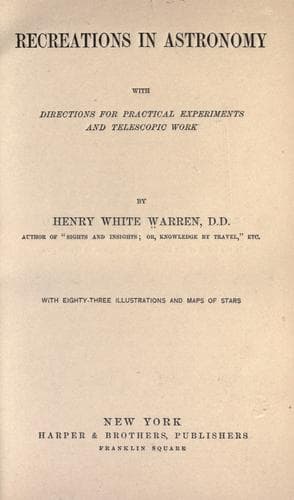
Recreations in Astronomy: With Directions for Practical Experiments and Telescopic WorkWarren, Henry White
Religion
Recreations in Astronomy: With Directions for Practical Experiments and Telescopic Work
Warren, Henry White
Astronomy
ABBREVIATIONS used in astronomies, 275.
ABERRATION OF LIGHT (_a wandering away_), an apparent
displacement of a star, owing to the progressive motion of light
combined with that of the earth and its orbit, 199.
AEROLITE (_air-stone_), 122.
AIR, refraction of the, 40.
ALGOL, the variable star, 222.
ALMANAC, Nautical, 71; explanation of signs used, 275.
ALPHABET, Greek, 275.
ALTITUDE, angular elevation of a body above the horizon.
ANGLE, difference in directions of two straight lines that meet.
ANNULAR (_ring-shaped_) ECLIPSES, 158; nebulæ, 218, 220.
APHELION, the point in an orbit farthest from the sun.
APOGEE, the point of an orbit which is farthest from the earth.
APSIS, plural _apsides_, the line joining the aphelion and
perihelion points; or the major axis of elliptical orbits.
ARC, a part of a circle.
ASCENSION, RIGHT, the angular distance of a heavenly body from
the first point of Aries, measured on the equator.
ASTEROIDS (_star-like_), 162; orbits of interlaced, 74.
ASTRONOMICAL INSTRUMENTS, 43.
ASTRONOMY, use of, 57.
ATOM, size of, 255; power of, 256.
AURORA BOREALIS, 143.
AXIS, the line about which a body rotates.
AZIMUTH, the angular distance of any point or body in the horizon
from the north or south points.
BAILEY'S BEADS, dots of light on the edge of the moon seen in a
solar eclipse, caused by the moon's inequalities of surface.
BASE LINE, 68.
BIELA'S COMET, 129.
BINARY SYSTEM, a double star, the component parts of which
revolve around their centre of gravity.
BODE'S LAW of planetary distances is no law at all, but a study
of coincidences.
BOLIDES, small masses of matter in space. They are usually
called meteors when luminous by contact with air, 120.
[Page 280]
CELESTIAL SPHERE, the apparent dome in which the heavenly bodies
seem to be set; appears to revolve, 3.
CENTRE OF GRAVITY, the point on which a body, or two or more
related bodies, balances.
CENTRIFUGAL FORCE (_centre fleeing_).
CHROMOLITHIC PLATE of spectra of metals, to face 50.
CIRCUMPOLAR STARS, map of north, 201.
COLORS OF STARS, 214.
COLURES, the four principal meridians of the celestial sphere
passing from the pole, one through each equinox, and one through
each solstice.
COMETS, 126; Halley's, 128; Biela's lost, 129; Encke's, 130;
constitution of, 131; will they strike the earth? 133.
CONJUNCTION. Two or more bodies are in conjunction when they
are in a straight line (disregarding inclination of orbit) with the
sun. Planets nearer the sun than the earth are in inferior
conjunction when they are between the earth and the sun; superior
conjunction when they are beyond the sun.
CONSTELLATION, a group of stars supposed to represent some figure:
circumpolar, 201; equatorial, for December, 202; for January, 203;
April, 204; June, 205; September, 206; November, 207; southern
circumpolar, 208.
CULMINATION, the passage of a heavenly body across the meridian
or south point of a place; it is the highest point reached in its
path.
Public-domain text, read in full here on John Shaqi.
Reviews
Reviews
No reviews yet
Be the first to share your thoughts on this work.
Elsewhere in the archive
Join the Discussion
Join the discussion
Sign in to leave a comment or review.
Sign InorCreate an account