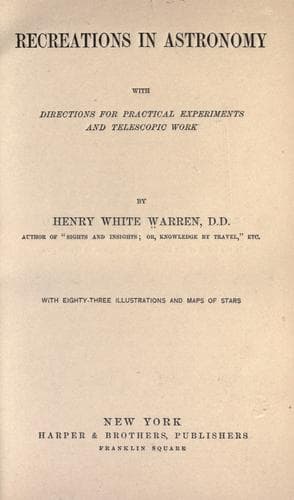
Recreations in Astronomy: With Directions for Practical Experiments and Telescopic WorkWarren, Henry White
Religion
Recreations in Astronomy: With Directions for Practical Experiments and Telescopic Work
Warren, Henry White
Astronomy
velocity of, 22; undulatory and musical, 26; chemical force of, 30;
experiments with, 37; approach and departure of a light-giving
body measured, 51; aberration of, 199.
LIMB, the edge of the disk of the moon, sun, or a planet.
LONGITUDE. If a perpendicular be dropped from a body to the
ecliptic, its celestial longitude is the distance of the foot of the
perpendicular from the vertical equinox, counted toward the east;
mode of ascertaining terrestrial, 72.
MAGELLANIC CLOUDS, 208.
[Page 282]
MARS, 159; snow spots of, 160; satellites of, 161.
MASS, the quantity of matter a body contains.
MEAN DISTANCE OF A PLANET, half the sum of the aphelion and
perihelion distances.
MEASUREMENTS, celestial, 57.
MERCURY, 138.
MERIDIAN, terrestrial, of a place, a great circle of the heavens
passing through the poles, the zenith, and the north and south points
of the horizon; celestial, any great circle passing from one pole
to the other.
METEORS, 119; swarm of, meeting the earth, 118; explosion of, 120;
systems of, 123; relation of, to comets, 124.
MICROMETER, any instrument for the accurate measurement of very
small distances or angles.
MIND, origin of force, 252; continuous relation of, to the
universe, 252.
MILKY WAY, 210, 215.
MIRA, the Wonderful, 221.
MOON, the, 151; greatest and least distance from the earth, 10;
telescopic appearance of, 155.
MURAL CIRCLE, 61.
NADIR, the point in the celestial sphere directly beneath our feet,
opposite to zenith.
NEBULÆ, 217.
NEBULAR HYPOTHESIS, not atheistic, 182; stated, 182; confirmatory
facts, 183; objections to, 185.
NEPTUNE, elements of, 175.
NODE, the point in which an orbit intersects the ecliptic, or
other plane of reference; ascending, descending, line of, 107.
OCCULTATION, the hiding of a star, planet, or satellite by the
interposition of a nearer body of greater angular magnitude.
OPPOSITION. A superior planet is in opposition when the sun,
earth, and the planet are in a line, the earth being in the middle.
ORBIT, the path of a planet, comet, or meteor around the sun, or of
a satellite around a primary; inclination of, 106; earth's, seen
from the stars, 70.
OUTLINE FOR STUDENTS, 276.
PARALLAX, the difference of direction of a heavenly body as seen
from two points, as the centre of the earth and some point of its
surface, 69.
PARALLELS, imaginary circles on the earth or in the heavens parallel
to the equator, having the poles for their centre.
PERIGEE, nearest the earth; said of a point in an orbit.
PERIHELION, the point of an orbit nearest the sun.
PERIODIC TIME, time of a planet's, comet's, or satellite's
revolution.
PERSONAL EQUATION, 65.
PERTURBATION, the effect of the attractions of the planets or other
[Page 283]
bodies upon each other, disturbing their regular motion; of Saturn
and Jupiter, 11; of asteroids, 13; of Uranus and Neptune, 176.
PHASES, the portions of the illuminated half of the moon or
Public-domain text, read in full here on John Shaqi.
Reviews
Reviews
No reviews yet
Be the first to share your thoughts on this work.
Elsewhere in the archive
Join the Discussion
Join the discussion
Sign in to leave a comment or review.
Sign InorCreate an account