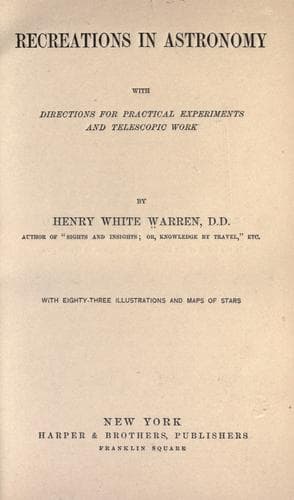
Recreations in Astronomy: With Directions for Practical Experiments and Telescopic WorkWarren, Henry White
Religion
Recreations in Astronomy: With Directions for Practical Experiments and Telescopic Work
Warren, Henry White
Astronomy
The speed of this orbital revolution must be proportioned to the
distance from the sun. The attraction of the sun varies inversely
as the square of the distance. [Page 100] It holds a planet with a
certain power; one twice as far off, with one-fourth that power.
This attraction must be counterbalanced by centrifugal force; great
force from great speed when attraction is great, and small from less
[Page 101] speed when attractive power is diminished by distance.
Hence Mercury must go 29.5 miles per second--seventy times as fast
as a rifle-ball that goes two-fifths of a mile in a second--or be
drawn into the sun; while Neptune, seventy-five times as far off,
and hence attracted only 1/5626 as much, must be slowed down to 3.4
miles a second to prevent its flying away from the feebler
attraction of the sun. The orbital velocity of the various planets
in miles per second is as follows:
Mercury 29.55 | Jupiter 8.06
Venus 21.61 | Saturn 5.95
Earth 18.38 | Uranus 4.20
Mars 14.99 | Neptune 3.36
Hence, while the earth makes one revolution in its year, Mercury
has made over four revolutions, or passed through four years; the
slower Neptune has made only 1/164 of one revolution.
The time of axial revolution which determines the length of the
day varies with different planets. The periods of the four planets
nearest the sun vary only half an hour from that of the earth,
while the enormous bodies of Jupiter and Saturn revolve in ten
and ten and a quarter hours respectively. This high rate of speed,
and its resultant, centrifugal force, has aided in preventing these
bodies from becoming as dense as they would otherwise be--Jupiter
being only 0.24 as dense as the earth, and Saturn only 0.13. This
extremely rapid revolution produces a great flattening at the poles.
If Jupiter should rotate four times more rapidly than it does, it
could not be held together compactly. As it is, the polar diameter
is five thousand miles less than the equatorial: the difference
in diameters produced by the [Page 102] same cause on the earth,
owing to the slower motion and smaller mass, being only twenty-six
miles. The effect of this will be more specifically treated
hereafter.
The difference in the size of the planets is very noticeable. If
we represent the sun by a gilded globe two feet in diameter, we
must represent Vulcan and Mercury by mustard-seeds; Venus, by a
pea; Earth, by another; Mars, by one-half the size; Asteroids, by
the motes in a sunbeam; Jupiter, by a small-sized orange; Saturn,
by a smaller one; Uranus, by a cherry; and Neptune, by one a little
larger.
Public-domain text, read in full here on John Shaqi.
Reviews
Reviews
No reviews yet
Be the first to share your thoughts on this work.
Elsewhere in the archive
Join the Discussion
Join the discussion
Sign in to leave a comment or review.
Sign InorCreate an account