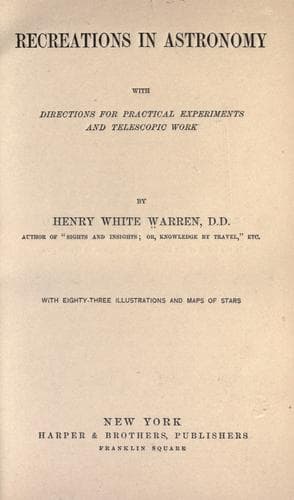
Recreations in Astronomy: With Directions for Practical Experiments and Telescopic WorkWarren, Henry White
Religion
Recreations in Astronomy: With Directions for Practical Experiments and Telescopic Work
Warren, Henry White
Astronomy
_The Great Comet of_ 1843 passed nearer the sun than any known
body. It almost grazed the sun. If it ever returns, it will be in
A.D. 2373.
_Donati's Comet of_ 1858.--This was one of the most magnificent
of modern times. During the first three months it showed no tail,
but from August to October it had developed one forty degrees in
length. Its period is about two thousand years. Every reader remembers
the comet of the summer of 1875.
_Encke's Comet._--This comet has become famous for its supposed
confirmation of the theory that space was filled with a substance
infinitely tenuous, which resisted the passage of this gaseous
body in an appreciable degree, and in long ages would so retard
the motion of all the planets that gravitation would draw them
all one by one into the sun. We must not be misled by the term
retardation to suppose it means behind time, for a retarded body
is before time. If its velocity is diminished, the attraction of
the sun causes it to take a smaller orbit, and smaller orbits mean
increased speed--hence the supposed retardation would shorten its
periodic time. This comet was thought to be retarded two and a
half hours at each revolution. If it was, it would not prove the
existence of the resisting medium. Other causes, unknown to us,
might account for it. Subsequent and more exact calculations fail
to find any retardations in at least two revolutions between 1865
and [Page 131] 1871. Indications point to a retardation of one and a
half hours both before and since. But such discrepancy of result
proves nothing concerning a resisting medium, but rather is an
argument against its existence. Besides, Faye's comet, in four
revolutions of seven years each, shows no sign of retardation.
The truth may be this, that a kind of atmosphere exists around the
sun, perhaps revealed by the zodiacal light, that reaches beyond
where Encke's comet dips inside the orbit of Mercury, and thus
retards this body, but does not reach beyond the orbit of Mars,
where Faye's comet wheels and withdraws.
_Of what do Comets consist?_
Public-domain text, read in full here on John Shaqi.
Reviews
Reviews
No reviews yet
Be the first to share your thoughts on this work.
Elsewhere in the archive
Join the Discussion
Join the discussion
Sign in to leave a comment or review.
Sign InorCreate an account