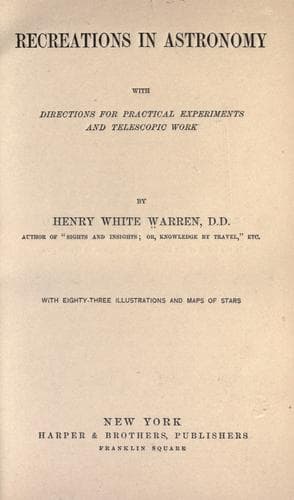
Recreations in Astronomy: With Directions for Practical Experiments and Telescopic WorkWarren, Henry White
Religion
Recreations in Astronomy: With Directions for Practical Experiments and Telescopic Work
Warren, Henry White
Astronomy
The same peculiarities are always evident in the visible face of
the moon; hence we know that it always presents the same side to
the earth. Obviously it must make just one axial to one orbital
revolution. Hold any body before you at arm's-length, revolve it
one-quarter around you until exactly overhead. If it has not revolved
on an axis between the hands, another quarter of the surface is
visible; but if in going up it is turned a quarter over, by the
hands holding it steady, the same side is visible. Three causes
enable us to see a little more than half the moon's surface: 1. The
speed with which it traverses the ellipse of its orbit is variable.
It sometimes gets ahead of us, sometimes behind, and we see farther
around the front or back part. 2. The axis is a little inclined to
the plane of its orbit, and its orbit a little inclined to ours;
hence we see a little over its north pole, and then again over
the south pole. 3. The earth being larger, its inhabitants see
a little more than half-way around a smaller body. These causes
combined enable us to see 576/1000 of the moon's surface. Our eyes
will never see the other side of the moon. If, now, being solid,
her axial revolution could [Page 153] be increased enough to make
one more revolution in two or three years, that difference between
her axial and orbital revolution would give the future inhabitants
of the earth a view of the entire circumference of the moon. Yet if
the moon were once in a fluid state, or had oceans on the surface,
the enormous tide caused by the earth would produce friction enough,
as they moved over the surface, to gradually retard the axial
revolution till the two tidal elevations remained fixed toward and
opposite the earth, and then the axial and orbital revolutions would
correspond, as at present. In fact, we can prove that the form of
the moon is protuberant toward the earth. Its centre of gravity is
thirty-three miles beyond its centre of magnitude, which is the same
in effect as if a mountain of that enormous height rose on the earth
side. Hence any fluid, as water or air, would flow round to the
other side.
The moon's day, caused by the sun's light, is 29-1/2 times as long
as ours. The sun shines unintermittingly for fifteen days, raising a
temperature as fervid as boiling water. Then darkness and frightful
cold for the same time succeed, except on that half where the earth
acts as a moon. The earth presents the same phases--crescent, full,
and gibbous--to the moon as the moon does to us, and for the same
causes. Lord Rosse has been enabled, by his six-foot reflector, to
measure the difference of heat on the moon under the full blaze
of its noonday and midnight. He finds it to be no less than five
hundred degrees. People not enjoying extremes of temperature should
shun a lunar residence. The moon gives us only 1/6180000 as much
light as the sun. A sky full of moons would scarcely make daylight.
Public-domain text, read in full here on John Shaqi.
Reviews
Reviews
No reviews yet
Be the first to share your thoughts on this work.
Elsewhere in the archive
Join the Discussion
Join the discussion
Sign in to leave a comment or review.
Sign InorCreate an account