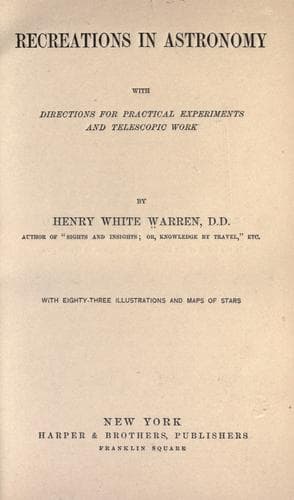
Recreations in Astronomy: With Directions for Practical Experiments and Telescopic WorkWarren, Henry White
Religion
Recreations in Astronomy: With Directions for Practical Experiments and Telescopic Work
Warren, Henry White
Astronomy
It is seen by the above table that all these moons are larger than
ours, one larger than Mercury, and the asteroids are hardly large
enough to make respectable moons for them. They differ in color:
I. and II. have a bluish tinge; III. a yellow; and IV. is red.
The amount of light given by these satellites varies in the most
sudden and inexplicable manner. Perhaps it may be owing to the
different distributions of land and water on them. The mass of all
of them is .000171 of Jupiter.
[Page 167]
If the Jovian system were the only one in existence, it would be
a surprising object of wonder and study. A monster planet, 85,000
miles in diameter, hung on nothing, revolving its equatorial surface
forty-five miles a minute, holding four other worlds in steady
orbits, some of them at a speed of seven hundred miles a minute,
and the whole system carried through space at five hundred miles
a minute. Yet the discovery of all this display of power, skill,
and stability is only reading the easiest syllables of the vast
literature of wisdom and power.
SATURN.
The god or time; sign [Symbol], his scythe.
MEAN DISTANCE FROM THE SUN, 881,000,000 MILES. DIAMETER, POLAR,
66,500 MILES; EQUATORIAL, 73,300 MILES. AXIAL REVOLUTION, 10H.
14M. PERIODIC TIME, 29T YEARS. MOONS, EIGHT.
The human mind has used Saturn and the two known planets beyond
for the last 200 years as a gymnasium. It has exercised itself
in comprehending their enormous distances in order to clear those
greater spaces, to where the stars are set; it has exercised its
ingenuity at interpreting appearances which signify something other
than they seem, in order that it may no longer be deluded by any
sunrises into a belief that the heavenly dome goes round the earth.
That a wandering point of light should develop into such amazing
grandeurs under the telescope, is as unexpected as that every tiny
seed should show peculiar markings and colors under the microscope.
[Illustration: Fig. 65.--View of Saturn and his Rings.]
There are certain things that are easy to determine, such as size,
density, periodic time, velocity, etc.; but other things are exceedingly
difficult to determine. It requires long sight to read when the
book is held [Page 168] 800,000,000 miles away. Only very few, if
more than two, opportunities have been found to determine the time
of Saturn's rotation. On the evening of December 7th, 1870,
Professor Hall observed a brilliant white spot suddenly show itself
on the body of this planet. It was as if an eruption of white hot
matter burst up from the interior. It spread eastward, and remained
bright till January, when it faded. No such opportunity for getting
a basis on which to found a calculation of the time of the rotation
of Saturn has occurred since Sir William Herschel's observations;
and, very singularly, the two times deduced wonderfully
coincide--that of Herschel being 10h. 16m., that of Mr. Hall being
10h. 14m.
Public-domain text, read in full here on John Shaqi.
Reviews
Reviews
No reviews yet
Be the first to share your thoughts on this work.
Elsewhere in the archive
Join the Discussion
Join the discussion
Sign in to leave a comment or review.
Sign InorCreate an account