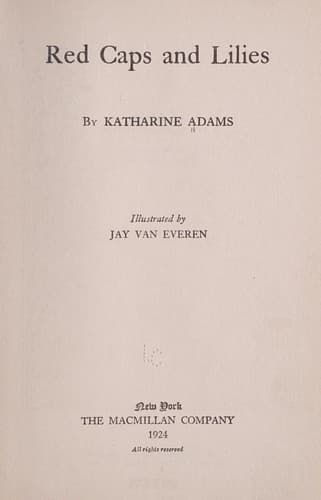
Children and war -- Juvenile fiction; France -- History -- Revolution, 1789-1799 -- Juvenile fiction
Marie Josephine was half asleep, her funny, tangled shock of hair on
Rosanne’s shoulder, but her eyes, when she looked up at Dian, were
bright with excitement.
“I may go to maman to-morrow, promise me, Dian. I told you in the alley
room that I would be patient about not seeing her to-night, but
to-morrow early I must go straight to her and to Great-aunt Hortense. It
will be quite safe for me in the streets in my disguise.” She caught his
arm and looked up at him as she spoke.
Dian looked down at Marie Josephine and said to her simply:
“There is real work for you to do to-morrow. You have come just in time,
and you have not come in vain, Little Mademoiselle. I hope that you will
see your mother to-morrow.”
CHAPTER XXII
CHAMPAR TO THE RESCUE
Grigge unfastened the sheepfold gate and then turned and faced Neville,
who stood beside him.
“You’d better stop worrying about those who are away, and keep your
worry for those at home,” he said.
“What do you mean by that, Grigge? There’s no danger to Les Vignes. The
trouble is all the other way,” Neville answered, leaning back against
the grey paling. He was tired out and covered with mud. He had just
returned from a vain attempt to find the runaways, and he was not eager
to face either the governess or Mother Barbette.
“Things happen quickly these days. You can’t tell what may happen next.
Your fine friends up at the house are none too safe. There were five
fires not so very far from here only last week. One of the houses burned
was the home of a friend of the old man’s.” By “the old man,” Grigge
meant Marie Josephine’s grandfather.
Neville’s face was white in the dancing sunshine. He was not able to
deny the truth of what Grigge said, and he was thinking of the two lost
children. He did not know what to do.
“Dian should never have gone away. It would be better, a thousand times
better, to have Dian with us,” he said.
Grigge nodded. Here was one point on which he thoroughly agreed with
Neville.
“That’s true! He shouldn’t have wasted his time looking out for those
that don’t deserve it. He’s worth all of them put together!” he said.
Then he suddenly thought of the fight he had had with Jean, and of how
the Little Mademoiselle had cried out, “What would Dian say!” As he
stood there kicking his heels against the wooden gate, Grigge knew that
he cared more about what Dian would say than about anything else in the
world, for Dian had helped him to keep his hold on life, and to fight
despair. He had taught him to love the sun and the stars, the flowers
and the young animals. It was easier to love these than to love people.
Public-domain text, read in full here on John Shaqi.
Reviews
Reviews
No reviews yet
Be the first to share your thoughts on this work.
Elsewhere in the archive
Join the Discussion
Join the discussion
Sign in to leave a comment or review.
Sign InorCreate an account