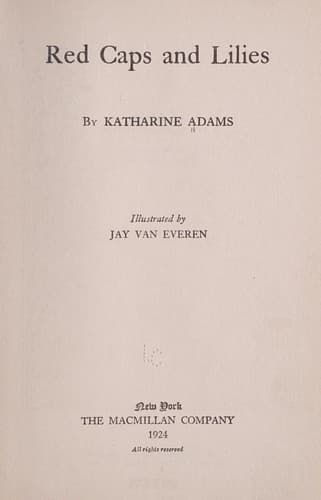
Children and war -- Juvenile fiction; France -- History -- Revolution, 1789-1799 -- Juvenile fiction
So Champar told them. At noon they would meet the cart that had taken
their mother out of Paris. It would be waiting for them at a farmhouse
he knew well. It had had a day’s start and was lightly loaded and there
had been no reason for making détours as their mother’s passport was en
règle and no one would suspect Henri Berier’s sister of being an
aristocrat! They would see their mother by noon that day!
Marie Josephine and Rosanne jumped out at the next hill and walked up it
together. Toward the top they were joined by Lisle. Marie Josephine
picked a bunch of wild lilies, putting them in the buttonhole of her
jacket. Jean was on the box talking to Champar as on that night that
Champar had given the two runaways a lift. Now and then the driver put
his hands over his ears as Jean plied him with questions.
“It’s been so wonderful! Sometimes it seems like a terrible, interesting
dream—but we won’t see Dian after we go to England.” Marie Josephine
turned her face away from the others toward a sweep of golden wild
lilies which gleamed like flakes of racing sunshine through the wood on
their right. She did not want them to see her tears. They fell unseen on
the lilies she had gathered.
“Maman! Maman! Maman!” The next moment she was screaming in an agony of
joy, all her acting forgotten, all her poise and self-control lost. The
coach had stopped by a lane which led from a farmhouse, and there stood
a dark-eyed, slovenly woman in a faded homespun dress—her maman!
Lisle and Marie Josephine sat on each side of the comtesse inside the
coach, Jean and Dian sat on the wide seat in front with Champar, who was
so ashamed of the tear that splashed over his big nose that he swore
under his breath and was cross to the horses. Maman could only hold
Marie Josephine in her arms; nothing seemed to matter except that and
the touch of Lisle’s hand on hers.
“My little dear one, my pigeon, my chérie,” she murmured over and over
to Marie Josephine, holding her close to her fast-beating heart.
“Darling, you came! It was you, my own little baby. I said there was
something—do you remember, chérie, how I told you, there by the garden
door, that there was something about you that reminded me of—of——?”
Maman’s head went down over Marie Josephine’s shock of tangled locks,
and she sobbed for a moment. Then she became more like her quiet,
self-contained self.
It all seemed a dream, the sweet afternoon air, the haze of heat, the
scent of the field lilies and early poppies. It was all a dream to Marie
Josephine, for she was very tired, but she felt her mother’s arms about
her and heard her mother’s endearing words, which sounded sweeter than
any she had ever heard before. They had always been there, locked deep
in the comtesse’s heart, but she had never known how much she wanted to
say them until it was, as she had thought, too late.
Public-domain text, read in full here on John Shaqi.
Reviews
Reviews
No reviews yet
Be the first to share your thoughts on this work.
Elsewhere in the archive
Join the Discussion
Join the discussion
Sign in to leave a comment or review.
Sign InorCreate an account