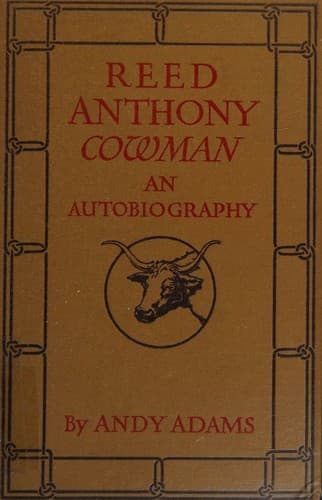
There is a close relationship between a cowman and his herds. My
insight into cattle character exceeds my observation of the human
family. Therefore I wish to confess my great love for the cattle of
the fields. When hungry or cold, sick or distressed, they express
themselves intelligently to my understanding, and when dangers of
night and storm and stampede threaten their peace and serenity, they
instinctively turn to the refuge of a human voice. When a herd was
bedded at night, and wolves howled in the distance, the boys on guard
easily calmed the sleeping cattle by simply raising their voices in
song. The desire of self-preservation is innate in the animal race,
but as long as the human kept watch and ward, the sleeping cattle had
no fear of the common enemy. An incident which I cannot explain, but
was witness to, occurred during the war. While holding cattle for the
Confederate army we received a consignment of beeves from Texas. One
of the men who accompanied the herd through called my attention to a
steer and vouchsafed the statement that the animal loved music,--that
he could be lured out of the herd with singing. To prove his
assertion, the man sang what he termed the steer's favorite, and to
the surprise of every soldier present, a fine, big mottled beef walked
out from among a thousand others and stood entranced over the simple
song. In my younger days my voice was considered musical; I could sing
the folk-songs of my country better than the average, and when
the herdsmen left us, I was pleased to see that my vocal efforts
fascinated the late arrival from Texas. Within a week I could call him
out with a song, when I fell so deeply in love with the broad-horn
Texan that his life was spared through my disloyalty. In the daily
issue to the army we kept him back as long as possible; but when our
supply was exhausted, and he would have gone to the shambles the
following day, I secretly cut him out at night and drove him miles to
our rear, that his life might be spared. Within a year he returned
with another consignment of beef; comrades who were in the secret
would not believe me; but when a quartette of us army herders sang
"Rock of Ages," the steer walked out and greeted us with mute
appreciation. We enjoyed his company for over a month, I could call
him with a song as far as my voice reached, and when death again
threatened him, we cut him to the rear and he was never spoken again.
Loyal as I was to the South, I would have deserted rather than have
seen that steer go to the shambles.
Public-domain text, read in full here on John Shaqi.
Reviews
Reviews
No reviews yet
Be the first to share your thoughts on this work.
Elsewhere in the archive
Join the Discussion
Join the discussion
Sign in to leave a comment or review.
Sign InorCreate an account