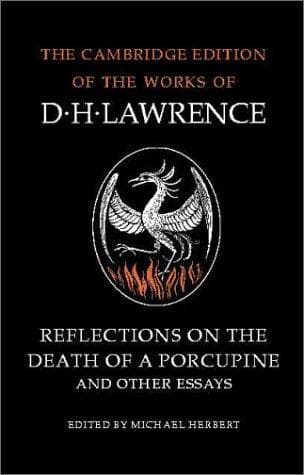
Reflections on the death of a porcupine and other essaysLawrence, D. H. (David Herbert)
Philosophy
Reflections on the death of a porcupine and other essays
Lawrence, D. H. (David Herbert)
English essays -- 20th century
And when I can turn my body to the sun, and say: “Sun! Sun!” and we
meet--then I am come finally into my own. For the universe of day,
finally, is the sun. And when the day of the sun is my day too, I am a
lord of all the world.
And at night, when the silence of the moon, and the stars, and the
spaces between the stars, is the silence of me too, then I am come into
my own by night. For night is a vast untellable life, and the Holy Ghost
starry, beheld as we only behold night on earth.
In his ultimate and surpassing relation, man is given only to that which
he can never describe or account for; the sun, as it is alive, and the
living night.
A man’s supreme moment of active life is when he looks up and is with
the sun, and is with the sun as a woman is with child. The actual yellow
sun of morning.
This makes man a lord, an aristocrat of life.
And the supreme moment of quiescent life is when a man looks up into the
night, and is gone into the night, so the night is like a woman with
child, bearing him. And this, a man has to himself.
The true aristocrat is the man who has passed all the relationships and
has met the sun, and the sun is with him as a diadem.
Cæsar was like this. He passed through the great relationships, with
ruthlessness, and came to the sun. And he became a sun-man. But he was
too unconscious. He was not aware that the sun for ever was beyond him,
and that only in his _relation_ to the sun was he deified. He wanted to
be God.
Alexander was wiser. He placed himself a god among men. But when blood
flowed from a wound in him, he said, “Look! It is the blood of a man
like other men.”
The sun makes man a lord: an aristocrat: almost a deity. But in his
consummation with night and the moon, man knows for ever his own passing
away.
But no man is man in all his splendour till he passes further than
every relationship: further than mankind and womankind, in the last leap
to the sun, to the night. The man who can touch both sun and night, as
the woman touched the garment of Jesus, becomes a lord and a saviour, in
his own kind. With the sun he has his final and ultimate relationship,
beyond man or woman, or anything human or created. And in this final
relation is he most intensely alive, surpassing.
Every creature at its zenith surpasses creation and is alone in the face
of the sun, and the night: the sun that lives, and the night that lives
and survives. Then we pass beyond every other relationship, and every
other relationship, even the intensest passion of love, sinks into
subordination and obscurity. Indeed, every relationship, even that of
purest love, is only an approach nearer and nearer, to a man’s last
consummation with the sun, with the moon or night. And in the
consummation with the sun, even love is left behind.
Public-domain text, read in full here on John Shaqi.
Reviews
Reviews
No reviews yet
Be the first to share your thoughts on this work.
Elsewhere in the archive
Join the Discussion
Join the discussion
Sign in to leave a comment or review.
Sign InorCreate an account