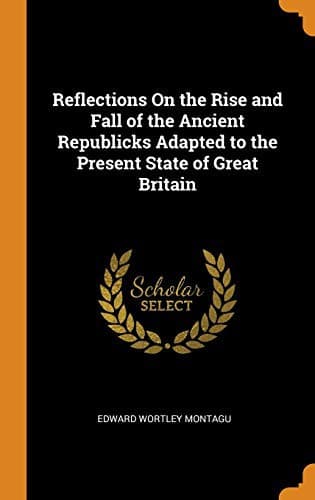
Reflections on the Rise and Fall of the Ancient Republicks: Adapted to the Present State of Great BritainMontagu, Edward Wortley
Philosophy
Reflections on the Rise and Fall of the Ancient Republicks: Adapted to the Present State of Great Britain
Montagu, Edward Wortley
History, Ancient -- Philosophy; Republics
Luxury, when introduced into free states, and suffered to be diffused
without controul through the body of the people, was ever productive of
that degeneracy of manners, which extinguished publick virtue, and put a
final period to liberty. For as the incessant demands of luxury quickly
induced necessity, that necessity kept human invention perpetually on
the rack to find out ways and means to supply the demands of luxury.
Hence the lower classes at first sold their suffrages in privacy and
with caution; but as luxury increased, and the manners of the people
grew daily more corrupt, they openly set them up to sale to the best
bidder. Hence too the ambitious amongst the higher classes, whose
superior wealth was frequently their only qualification, first purchased
the most lucrative posts in the state by this infamous kind of
traffick, and then maintained themselves in power by that additional
fund for corruption, which their employments supplied, until they had
undone those they had first corrupted.
But of all the ancient republicks, Rome in the last period of her
freedom was the scene where all the inordinate passions of mankind
operated most powerfully and with the greatest latitude. There we see
luxury, ambition, faction, pride, revenge, selfishness, a total
disregard to the publick good, and an universal dissoluteness of
manners, first make them ripe for, and then complete their destruction.
Consequently that period, by showing us more striking examples, will
afford us more useful lessons than any other part of their history.
Rome, once the mighty mistress of the universe, owed her rise, according
to Dionysius of Halicarnassus, the most curious and most exact inquirer
into the Roman antiquities, to a small colony of the Albans under the
conduct of Romulus, the supposed grandson of Numitor king of Alba. That
the Albans derived their origin from the Greeks seems highly probable
from the nature of the Alban and Roman monarchical government, which
appears to be plainly copied from Lycurgus.
Public-domain text, read in full here on John Shaqi.
Reviews
Reviews
No reviews yet
Be the first to share your thoughts on this work.
Elsewhere in the archive
Join the Discussion
Join the discussion
Sign in to leave a comment or review.
Sign InorCreate an account