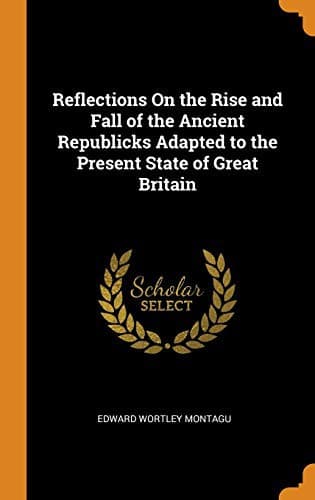
Reflections on the Rise and Fall of the Ancient Republicks: Adapted to the Present State of Great BritainMontagu, Edward Wortley
Philosophy
Reflections on the Rise and Fall of the Ancient Republicks: Adapted to the Present State of Great Britain
Montagu, Edward Wortley
History, Ancient -- Philosophy; Republics
Several of the poorer sort demanded an immediate
abolition of their debts, as the condition for their taking a share in
the dangers of the war, and looked upon this delay rather as an
imposition. The senate, who, as the event showed, were determined never
to grant their request, and yet were afraid of new commotions, resolved
to abolish the consulship, and all other magistracies for the present,
and to invest a new magistrate with absolute and unlimited power, and
subject to no account for his actions. This new officer was termed the
dictator, and the duration of his office was limited to six months, at
the end of which term the consuls were to resume their former authority.
The chief reason, as Dionysius informs us, which induced the senate to
make use of this dangerous expedient, was to evade that law which
Poplicola had procured in favour of the Plebeians, which made it death
for a magistrate to punish a Roman without a legal trial, or before he
was condemned by the people.[251] The senate then made a decree for the
election of a dictator, and the Plebeians ignorant, as Dionysius
observes, of the importance of that decree, not only confirmed the
resolutions of the senate, but gave up to them the power of choosing the
person who should be invested with that dignity. Titus Lartius, one of
the consuls, was nominated by his colleague according to the form at
that time agreed upon in the senate. When the dictator appeared in all
the pomp and grandeur of his new office, he struck a terror into the
most turbulent, and the people, thus tricked out of that law which was
their only protection, immediately submitted. Lartius, who seems to have
been one of the greatest men of his time, ordered in a general register
of all the Romans, and formed his army after that wise method first
instituted by Servius Tullius. When he took the field he persuaded the
Latins, by his singular address, to disband their forces and conclude a
truce, and thus diverted the impending storm without fighting. He then
returned home, and resigned his office before the time was expired,
without having exercised any one act of severity upon a single Roman. A
noble instance of moderation and publick virtue!
Public-domain text, read in full here on John Shaqi.
Reviews
Reviews
No reviews yet
Be the first to share your thoughts on this work.
Elsewhere in the archive
Join the Discussion
Join the discussion
Sign in to leave a comment or review.
Sign InorCreate an account