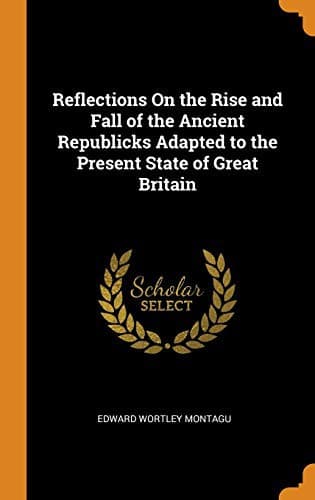
Reflections on the Rise and Fall of the Ancient Republicks: Adapted to the Present State of Great BritainMontagu, Edward Wortley
Philosophy
Reflections on the Rise and Fall of the Ancient Republicks: Adapted to the Present State of Great Britain
Montagu, Edward Wortley
History, Ancient -- Philosophy; Republics
reduced the commonwealth to its present desperate situation.” He
concluded by seconding the motion of Menenius for sending ambassadours
to put a speedy end to the sedition upon the best terms they should be
able to obtain.
Appius, finding himself thus personally attacked, rose up and replied to
Valerius in a hot inflammatory speech full of the most virulent
invectives. He denied that he was ever guilty of enslaving his debtors:
“he denied too, that those who had acted in that manner could be charged
with injustice, since they had done no more than the laws allowed. He
affirmed that the imputation of being an enemy to the people, and
favouring oligarchy, arose from his steady adherence to the aristocracy,
and equally affected all those of superior worth, who like him disdained
to be governed by their inferiors, or to suffer the form of government
which they had inherited from their ancestors[258] to deviate into the
worst of all constitutions, a democracy. He recriminated upon Valerius,
and charged him with aiming at tyranny, by courting the most profligate
of the citizens, as the most effectual and shortest way of enslaving his
country. He termed the seceders, vile, mean wretches, a thoughtless
senseless multitude, whose present arrogance had been first inspired by
that old man, as he contemptuously called Valerius. He declared
absolutely against sending ambassadours, or making the least
concession, and advised rather to arm the slaves and send for assistance
from their allies the Latins, than submit to any thing that might
derogate from the power and dignity of the Patricians. He proposed, if
the seceders should appear in arms against them, to put their wives and
children to death before their faces by the most severe and ignominious
tortures. But if they would submit at discretion to the senate, he
advised to treat them with moderation.” This speech produced a violent
tumult in the senate, and the young Patricians who adhered to Appius
behaved with so much insolence, that the consuls threatened to exclude
them from the publick counsels, by a law which should fix the age for
the qualification of every senator. Nothing was determined at that time,
but in a few days, the moderate party, supported by the firmness of the
consuls, prevailed against the still inflexible Appius, and ten
ambassadours, at the head of whom were Menenius and Valerius, were sent
with full powers to treat with the seceders. After many debates,
Menenius in the name of the senate promised full redress of all their
grievances with respect to the debts, and offered to confirm this
promise by the solemn oaths of all the ambassadours. His offer was upon
the point of being accepted, when Lucius Junius, who affected the
surname of Brutus, a bold and able Plebeian, interposed and insisted
upon such a security from the senate as might protect the Plebeians for
the future from the power of their enemies, who might find an
Public-domain text, read in full here on John Shaqi.
Reviews
Reviews
No reviews yet
Be the first to share your thoughts on this work.
Elsewhere in the archive
Join the Discussion
Join the discussion
Sign in to leave a comment or review.
Sign InorCreate an account