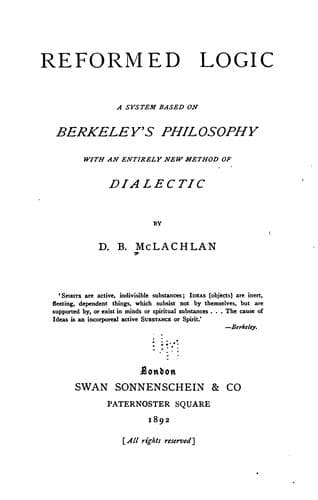
Reformed Logic: A System Based on Berkeley's Philosophy with an Entirely New Method of DialecticMcLachlan, D. B.
Philosophy
Reformed Logic: A System Based on Berkeley's Philosophy with an Entirely New Method of Dialectic
McLachlan, D. B.
Logic
_Ferio_ in the same manner is reduced to _Celarent_. The dotted part
of C is cut away, and the part really significant in the syllogism is
called E. Then 'No B is A, all E is B, no E is A.'
Finally _Celarent_ can be reduced to _Barbara_. B cannot indeed be
enclosed in A, but we assume the existence of a whole having all the
characters which A has _not_, or having none of the characters which
A has. This is the whole F = Not-A. Then _Celarent_ becomes _Barbara_
thus: 'All B is F, all C is B, therefore all C is F.'
This demonstrates that there is only one fundamental operation where
syllogists suppose there are at least four. The difference is wholly a
matter of language, and disappears on changing the names of the terms
and ignoring irrelevant suggestions. But the syllogism, I repeat, does
not represent the act of reasoning, and its moods and figures are fit
only to be a game for children.
[Footnote 20: _Logic_, Book I. § 3.]
[Footnote 21: _Logic_, Book II. c. 3. § 2.]
[Footnote 22: _Lectures_, iii. pp. 287 and 356. The
impossibility of reconciling their definitions and rules to
real thinking and argument is the despair of logicians. Most
of them take to symbols, which are more accommodating than
real experience, having just such properties as their makers
choose to put in them. Sir William Hamilton had the courage to
declare that a logician might use arguments of a concrete or
real form, but that it is not necessary they should agree with
real fact. 'The logician has a right to suppose any material
impossibility, any material falsity; he takes no account of
what is objectively impossible or false, he has a right to
assume what premises he please, provided that they do not
involve a contradiction in terms.'--_Id._ 322. That means
in plain English that a logician may misrepresent matters of
fact, if he cannot otherwise establish his theory!]
[Footnote 23: _Laws of Thought_, p. 35.]
[Footnote 24: _Ibid._ p. 47.]
STUDIES IN DIALECTIC
XXXIX
The theorems given for practice in logic books are useful dialectic
material, but they do not fully illustrate all the categories.
Logicians have no definite categories, and in selecting examples they
are unconsciously biassed in favour of those that can be most easily
interpreted to signify classification. The really generalistic
examples are rare; the most are judgments of inherence, admitted in
virtue of the assumption that inherent properties can--when it
is needful to preserve the traditional notion of predication--be
considered class-ideas. Theorems in perspection and concretion we do
not expect to find in logic books, for these, in so far as they are
distinct from association, are categories peculiar to the Berkeleyan
philosophy.
Public-domain text, read in full here on John Shaqi.
Reviews
Reviews
No reviews yet
Be the first to share your thoughts on this work.
Elsewhere in the archive
Join the Discussion
Join the discussion
Sign in to leave a comment or review.
Sign InorCreate an account