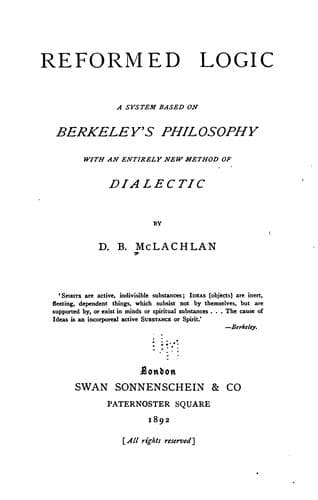
Reformed Logic: A System Based on Berkeley's Philosophy with an Entirely New Method of DialecticMcLachlan, D. B.
Philosophy
Reformed Logic: A System Based on Berkeley's Philosophy with an Entirely New Method of Dialectic
McLachlan, D. B.
Logic
The judgment in this category is therefore a consciousness of
position, such as those mentioned above. The argument is a completion
of one association by comparison with another--the expectation of
similarity in groups.
_Movement._ All judgments as to _change_ of position in objects come
under this category. It takes at least two things arranged in a group
to produce the perception of movement. If there were but one thing in
our field of observation we could not say whether it moved or not, for
there would be nothing which it would pass, or leave, or approach. It
would appear to stand still. There is, however, more in movement than
depends on mere perception.
All movement is due to energy either in the observer or in the other
mind acting upon his. Energy is not a generalisation of moving things,
nor a property, nor a relation, though all these may be signs of
energy. The most abstract idea of movement is _Motion_. It may be
defined as a series of positions.
_Number._ If we treat a group as a large loose object we shall
perceive in it certain properties not strictly positional. Number is
one of these.
A group of three coins has not the same practical value as a group
of six or sixty, and we are thus obliged to notice the difference and
distinguish degrees of this property by names--hence Arithmetic.
_Flat Space_ or space of two dimensions is another property of a
group. Grouped objects have frequently intervals between them.
Such intervals are negations of perception--interruptions or
discontinuities of experience. But by abstraction we can reduce the
objects bounding an interval to a geometrical line, and so give a sort
of positive existence to the interval. Thus we talk of a hole or of
darkness as if they were true objects, and measure them by standards
of length.
If we abstract the boundary lines from a space we get the idea
'intervalness,' which is the right name for two-dimensioned space.
This abstract idea is nearly the same as abstract size. Space is
interval without bounds--size is object without contents. Space and
size are equally _nothing_ intrinsically or in their own right,
but they have been reached by different modes of refining away the
positive qualities associated with them, and this difference of origin
is slightly suggested by their names. Spaces have a use in perception
similar to _rests_ in music--they relieve the attention and give
contrast and vigour to the next positive object.
XXIV--PERSPECTION
This is the first of the artificial categories. It is an ideal
treatment of an associated group to facilitate a certain kind of
reasoning.
Public-domain text, read in full here on John Shaqi.
Reviews
Reviews
No reviews yet
Be the first to share your thoughts on this work.
Join the Discussion
Join the discussion
Sign in to leave a comment or review.
Sign InorCreate an account